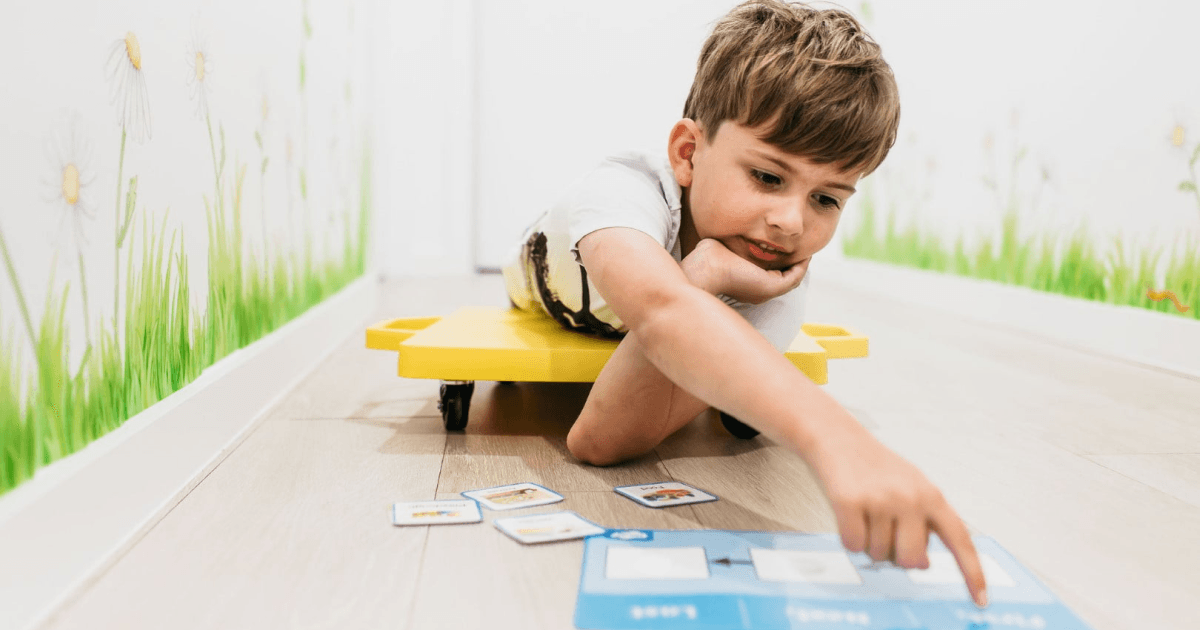
Visual schedules for children use pictures, symbols or words to show what is happening and what comes next. They can make everyday routines easier to understand, support smoother transitions and help children build confidence and independence at home, school or in therapy.
This guide explains when and how to use these visual supports, the different formats available and how to tailor one to your child. You will also find free printable examples and picture icons that you can download or customise using the BillyLids visual schedule builder.
What Is a Visual Schedule?
Visual Schedules are tools that use pictures, symbols, or written words to outline a sequence of activities, tasks, or steps in a process. They are designed to support understanding, predictability, and independence by visually representing what will happen and in what order.
Other common names include:
- First – Then Board – for simple sequences (e.g. First work, then bubbles).
- Visual Timetable – outlines the session structure step-by-step.
- Now-Next–Then Schedule – a slightly extended version of First-Then.
- Therapy Visual Routine – used to show the predictable flow of therapy.
- Choice Board – for offering child-led activity options.
- Visual Activity Planner – a more general term, still child-friendly.
Visual schedules are highly effective in therapy and other environments, offering numerous benefits for typically developing children and children with developmental delays, autism, ADHD, or other challenges.
Whether used at home, school, or in therapy, visual schedules create structure and predictability, making routines easier to understand and follow. They can be developed using printed images, drawn symbols, or digital applications and should always be tailored to the individual’s developmental level and speech, language and communication needs.
Types of Visual Schedules
Visual schedules come in many forms and can range from simple to complex, depending on the needs of the individual.
1. Basic “First-Then” Schedules:
These are simple schedules often used with younger children or those just starting with visual supports. They pair a task with a reward or a motivating activity. For example, “First: Put toys away. Then: Play outside.” This structure helps children understand that completing a task leads to something desirable, promoting motivation and cooperation.
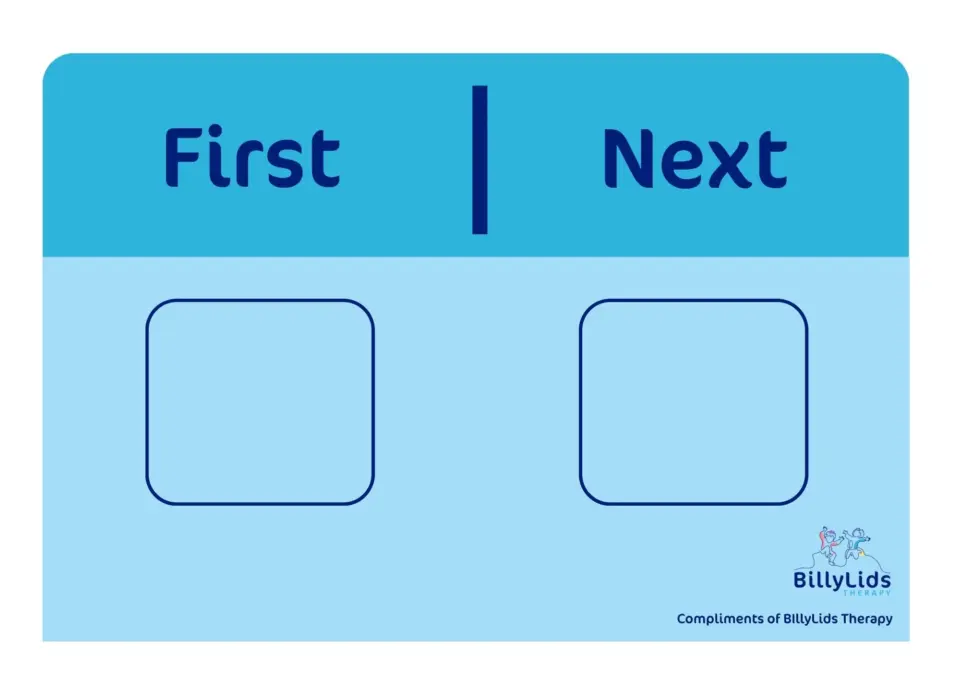
Download the Free Basic First-Then Schedule
2. Routine Schedules:
Routine schedules include a sequence of steps for recurring daily activities, such as a bedtime routine, a toileting routine, or getting ready for school. For example, a bedtime schedule might show images or symbols for brushing teeth, putting on pyjamas, reading a book, and going to bed. These schedules help children understand the sequence of activities and build independence over time.
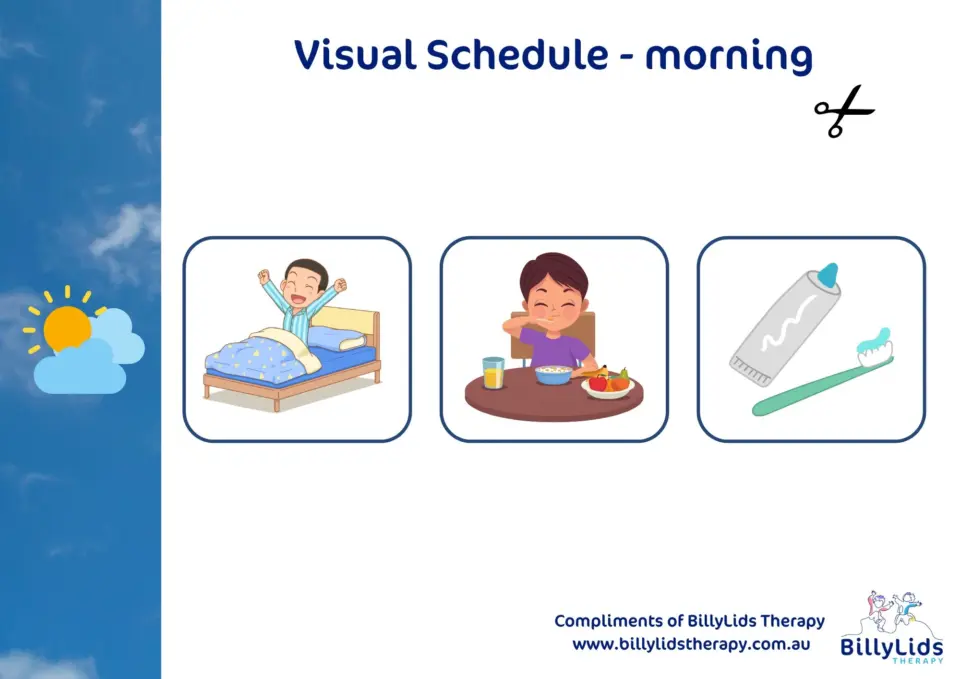
Download the Free Routine Schedule Example
3. Therapy Task Schedules:
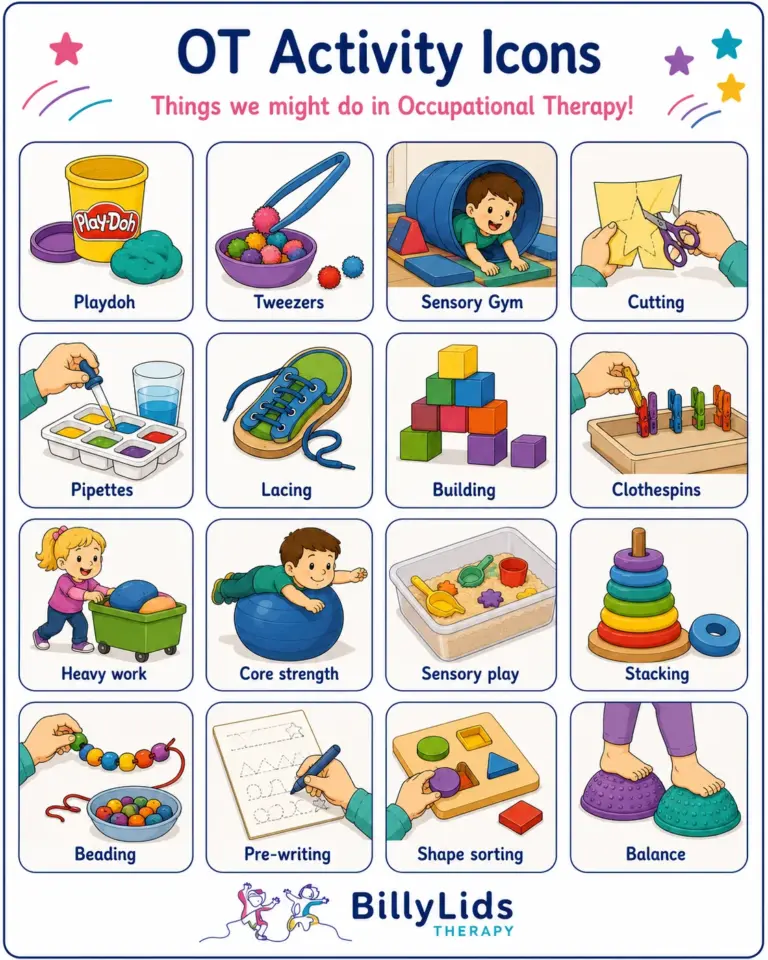
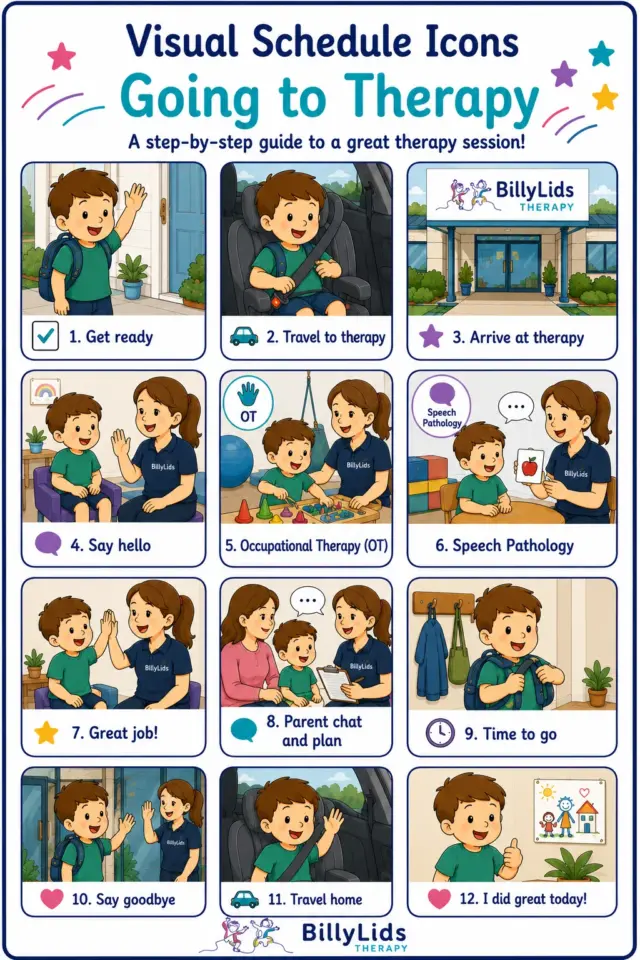
In therapy settings, visual schedules can outline a series of tasks or activities to complete during the session. For instance, an occupational therapy session might include sensory play, fine motor practice, and gross motor activities, ending with a preferred reward such as free play or a favourite game. This approach increases focus and motivation, as children can visually track their progress and anticipate the reward.
Download the Free Therapy Task Schedules
4. Professional Checklists
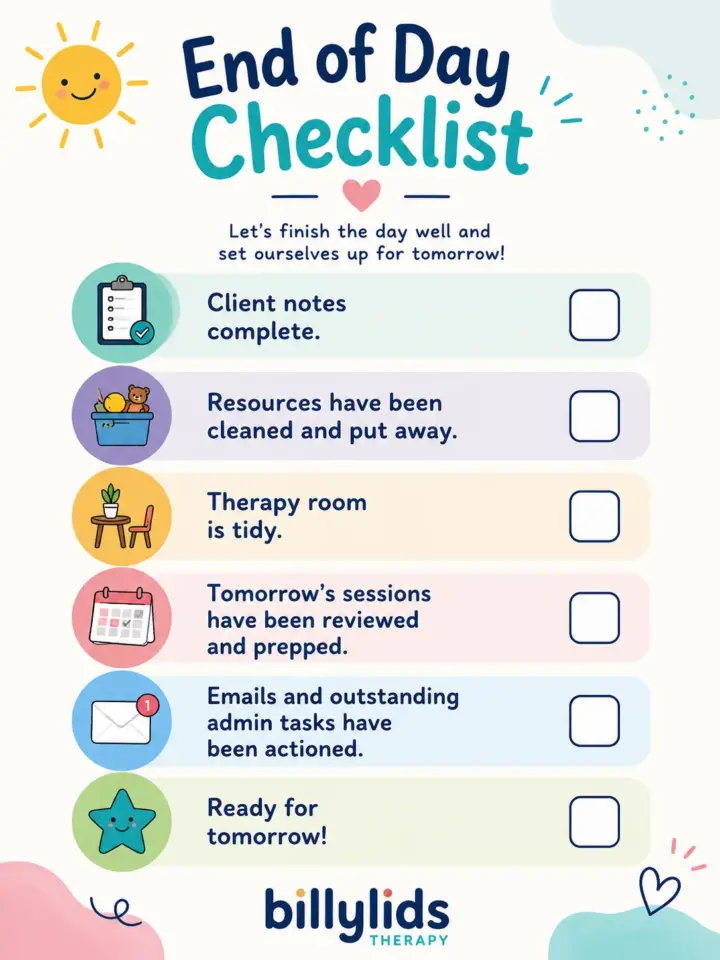
Visual schedules can also support therapists, teachers, and other professionals by providing a clear sequence of tasks throughout the day. Examples include an end-of-day checklist, therapy room set-up checklist, session preparation checklist, or school visit checklist. These schedules promote consistency, reduce cognitive load, and help ensure important tasks are completed before moving on to the next activity.
Download the Free Professional Checklists
When to Use Visual Schedules
Visual schedules are incredibly versatile tools that help children navigate routines, handle transitions, and develop independence. By visually outlining tasks, steps, or daily activities, they provide clarity and reduce anxiety, especially for children with developmental differences such as autism or ADHD. Here’s a closer look at when visual schedules are most effective and why they’re backed by research.
1. Helping Children Understand What Comes Next
Children thrive on predictability, and knowing what comes next helps them feel secure and prepared. Visual schedules provide a clear overview of upcoming activities, which is particularly helpful for children who process information better through visual rather than verbal input.
Why It’s Important:
Uncertainty can lead to anxiety, frustration, or disengagement. A visual schedule eliminates that uncertainty, giving children a sense of control over their environment.
What the Research Says:
- Studies show that children with autism spectrum disorder (ASD) demonstrate improved engagement and reduced challenging behaviours when visual supports are used to clarify expectations (Knight, Sartini, & Spriggs, 2015).
- For children with receptive language delays, visual schedules act as concrete representations of verbal instructions, making communication easier to understand (Hodgdon, 1995).
2. Managing Changes to Routine or New Situations
Transitions or unexpected changes can be difficult, particularly for children with sensory processing challenges, developmental delays or autism spectrum disorder (ASD). Visual schedules act as a “roadmap,” helping children anticipate and adapt to new or shifting routines.
Why It’s Important:
Transitions are often stressful, but visual schedules help children adjust by showing what’s next in a structured way. This reduces stress and promotes cooperation.
What the Research Says:
- Research shows that visual schedules can effectively prepare children for transitions, decreasing resistance and increasing participation (Dettmer et al., 2000).
- They also support flexibility by visually introducing changes, allowing children to shift attention from one activity to another (Massey & Wheeler, 2000).
3. Encouraging Independent Task Completion
Visual schedules empower children to complete tasks on their own, without needing frequent reminders or prompts from adults. By visually tracking steps or progress, children gain confidence in their abilities and develop autonomy.
Why It’s Important:
Independence fosters self-esteem and self-regulation, essential skills for long-term success. Visual schedules give children a sense of ownership over their tasks and routines.
What the Research Says:
- Studies have found that visual schedules increase independent task completion, helping children understand their responsibilities and follow through (Pierce et al., 2013).
- Research by MacDuff, Krantz, and McClannahan (1993) highlighted that visual schedules enabled children with ASD to independently complete task sequences without additional adult intervention.
4. Developing a New Skill
Visual schedules are not only helpful for managing routines and transitions but are also highly effective in teaching new skills. By breaking down a task into manageable steps, they provide children with clear guidance on what to do, reducing overwhelm and building confidence. Toileting is a great example of how visual schedules can be used to develop a new skill.
Why It’s Important:
Learning a new skill like toileting can be challenging, especially for children with developmental differences. Visual schedules simplify the process by outlining each step in a clear and predictable way. This approach helps children understand the sequence of actions, promotes consistency, and encourages independence.
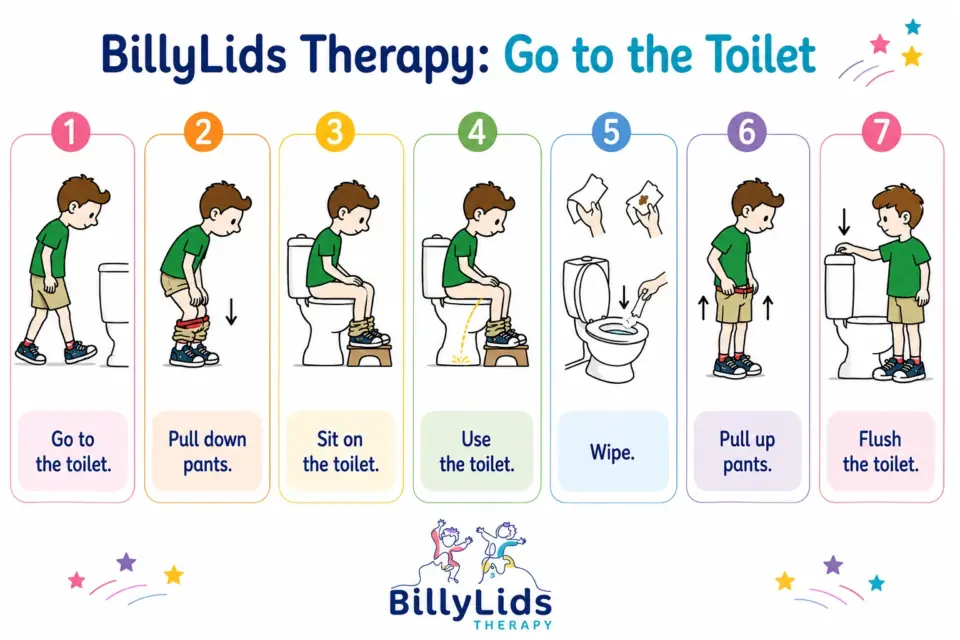
Example: Toileting
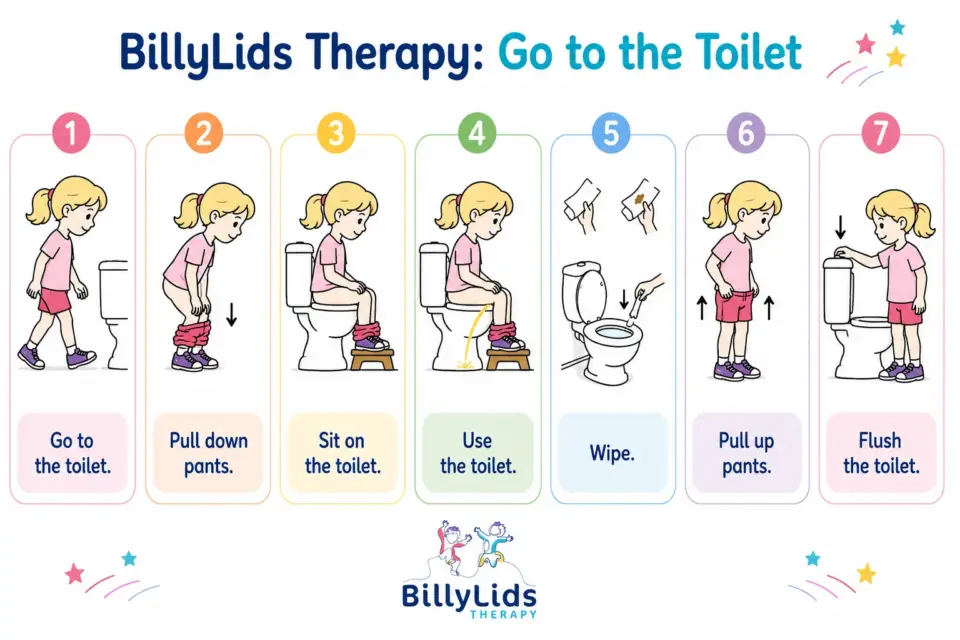
A toileting visual schedule might include steps like:
- Go to the toilet.
- Pull down pants.
- Sit on the toilet.
- Use the toilet.
- Wipe.
- Pull up pants.
- Flush the toilet.
Wipe Front to Back
A simple visual guide to support independent wiping. Wipe front to back, check, and keep wiping until clean.
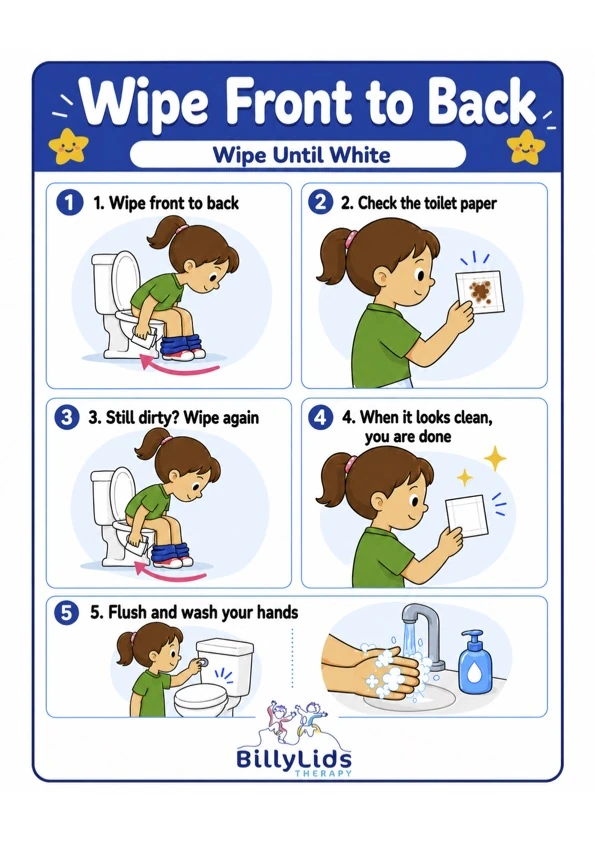
Download the Free Toileting Visual Schedules
Tailoring Visual Schedules to the Child
The key to success with visual schedules is customisation. By adapting them to a child’s specific needs, strengths, and environment, they become even more effective in fostering independence and reducing anxiety.
Why It’s Important:
Each child is unique, and a one-size-fits-all approach may not work. A tailored schedule ensures the child fully engages with the support provided.
What the Research Says:
- Individualised visual schedules aligned with a child’s strengths and preferences are significantly more effective (Hume, 2009).
- Tailored supports are also more likely to generalise across settings, meaning children can use the skills learned in one context in other areas of their lives (Massey & Wheeler, 2000).
How It Helps:
- Breaking Down the Process: Toileting involves multiple steps that can be overwhelming if taught as a whole. A visual schedule allows the child to focus on one step at a time.
- Encouraging Independence: As children become familiar with the schedule, they can follow it without constant parental reminders or prompts.
- Building Confidence: Successfully completing each step fosters a sense of accomplishment and encourages continued effort.
- Reducing Anxiety: Knowing exactly what to expect can alleviate stress, particularly for children who find new skills or changes in routine difficult.
What the Research Says:
- Visual schedules have been shown to improve skill acquisition in children with ASD and other developmental delays by providing a consistent and structured way to learn (MacDuff, Krantz, & McClannahan, 1993).
- Research highlights that visual supports reduce reliance on verbal prompts, enabling children to build independence in daily living skills (Knight, Sartini, & Spriggs, 2015).
Benefits of Visual Schedules
- Establishing consistency: Visual schedules offer a clear roadmap for the day, reducing unpredictability and creating a sense of routine.
- Supporting smoother transitions: They provide clear cues about when one activity will end and another will begin, minimising resistance or confusion.
- Emotional regulation: A predictable outline of activities can help reduce feelings of anxiety, especially in unfamiliar situations.
- Chunking: Schedules support children in breaking tasks into manageable steps, making it easier to follow a sequence.
- Increasing autonomy: Visual prompts empower children to complete tasks independently, boosting their confidence and skills.
- Teaching time and order: By visually displaying steps in progression, schedules help children understand concepts like sequencing and time management.
- Building self-worth: Completing items on a visual schedule gives children a sense of achievement and pride.
- Fostering early literacy: Pairing visuals with text encourages word recognition and builds foundational reading skills.
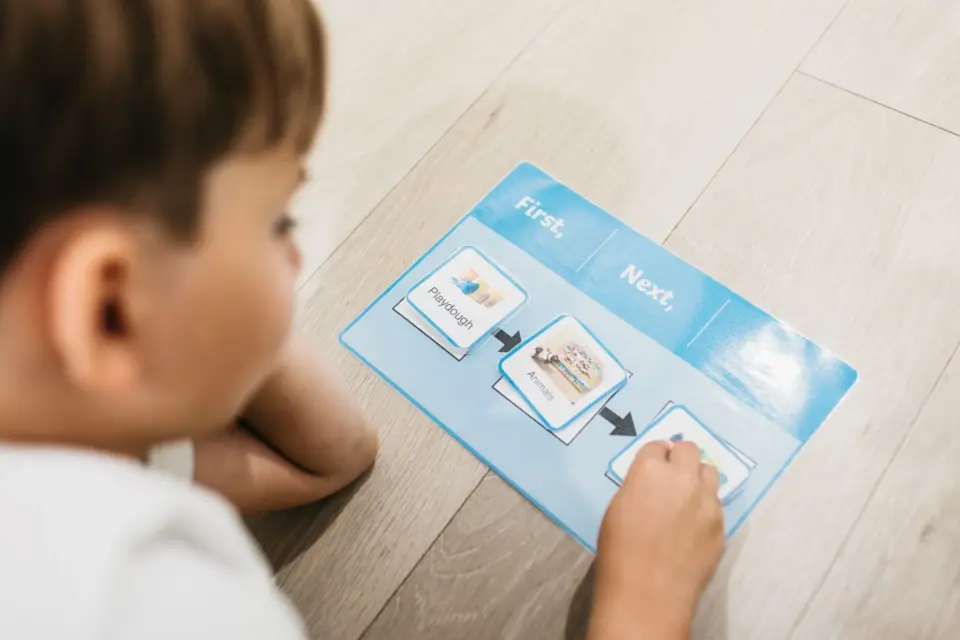
Where to Use Visual Schedules
Visual schedules can be used effectively in a range of environments, including:
- Home: To support daily routines like getting ready for school, bedtime, or meal preparation.
- Childcare centres: To provide a consistent daily structure, helping children transition smoothly between playtime, meals, and rest.
- School: To outline classroom routines, assignments, or transitions between lessons and activities.
- Therapy settings: To structure sessions and help children understand what to expect during interventions.
- Community settings: To prepare children for outings, such as visits to the doctor, shopping trips, or other public activities.
Free Visual Schedule Downloads
The free resources below are grouped by the number of steps and the type of routine they support. Preview the examples, then use the download button beneath each group to save the matching ZIP file. You can also customise a routine using the BillyLids visual schedule builder.
Basic “First-Then” Schedules
These simple First-Then boards are a good starting point for younger children or anyone new to picture-based supports. Use them to show one task followed by a preferred activity, then download the complete set using the button below.
Download the Free First-Then Templates
Three-Step Schedules
Three-step schedules suit short routines that need a little more detail, such as getting dressed, packing a bag or completing a simple classroom task. Preview the options, then download the complete set below.
Download the Free Three-Step Templates
Routine Schedules
Routine schedules break repeated activities into a predictable sequence. Choose a basic, extended or blank format based on how many steps your child needs and how much customisation would be helpful.
Morning routine – basic
The basic morning format works well for a short, familiar routine with only a few steps. Use the download button below the gallery to save the ready-to-print files.
- Use a visual schedule with transparent pictures to guide steps.
- Attach solid pictures with Velcro or Blu-Tack.
- The child adds them to the schedule when the task is complete.
Blank Visual Schedule – Add Your Own Picture icons
Use the blank template when you want to create a personalised sequence with your own photographs, drawings or BillyLids picture icons. Download the templates and icon pack below.
Download the Free Blank Templates and Picture Icons
Visual schedule – icons
These picture icons can be mixed and matched to represent common activities, self-care tasks, school routines and preferred activities. Download the ZIP file, then choose only the images that are meaningful to your child.
Download the Free Visual Schedule Picture Icons
Make a Visual Schedule
Creating a visual schedule tailored to your child’s needs is a straightforward process. Here’s how to get started:
- Select the Activities or Routine: Determine which tasks or routines you want to include in the schedule. This could be a morning routine (e.g., brushing teeth, getting dressed, eating breakfast) or steps for a specific activity like toileting.
- Find or Create Images: Use pictures, symbols, or photos to represent each step. You can:
- Create Your Own: Draw or take photos of each activity.
- Utilise Free BillyLids Downloads: BillyLids provides free downloadable visual schedule resources suitable for various routines.
- Add Labels (Optional): Including text under each image can support early literacy skills. Use simple words like “Brush Teeth” or “Get Dressed.” If your child is starting to engage in writing skills – have them write the labels.
- Print and Laminate: Printing the schedule on cardstock and laminating it enhances durability and reusability. Inexpensive laminators are available at stores like Officeworks or online retailers such as Kmart and Amazon Australia, typically ranging from $30 to $50.
- Attach Images: Use Blu-Tack or Velcro dots to affix the images to the schedule. Velcro is particularly useful for schedules where tasks are moved or removed upon completion. Velcro dots can be purchased from Bunnings, Spotlight, or craft stores. Blu-Tack is widely available at Woolworths, Coles, and Officeworks.
- Display the Schedule: Place the schedule in a visible location, such as on the fridge, a wall, or a portable board, depending on where it will be used.
- Model How to Use It: Demonstrate to your child how to follow the schedule by pointing to each step as you go. Offer praise for their progress and make adjustments as needed.
By utilising these resources and steps, you can create an effective visual schedule that supports your child’s understanding and independence in daily routines.
Final Thoughts
Visual schedules are a simple yet powerful way to enhance children’s ability to navigate their day, manage change, and achieve greater independence. Whether they’re used at home, in school, or in therapy, these tools help children build essential life skills while reducing stress and fostering confidence. Backed by extensive research, visual schedules are a must-have resource for parents, teachers, and therapists supporting children’s development.
If you would like to create a routine that suits your child, try the free visual schedule builder and choose the pictures and steps that work best for your family.
Further Reading
- Autism Queensland
autismqld.com.au
Autism Queensland offers workshops, consultations, and resources for parents and educators, including practical guidance on using visual schedules. - Early Childhood Development Programs (ECDPs)
Many Queensland schools offer ECDPs for children with developmental delays, where visual supports, including schedules, are commonly used. Contact your local school or regional office for more information. - Queensland Department of Education – Inclusion Support
The department provides resources and strategies for supporting children with additional needs, including how to implement visual supports in school and home settings.
Visit: education.qld.gov.au - Raising Children Network
raisingchildren.net.au
This Australian parenting website offers articles and videos on creating and using visual schedules effectively.
Academic Journals and Articles
- Dettmer, S., Simpson, R. L., Myles, B. S., & Ganz, J. B. (2000). The use of visual supports to facilitate transitions of students with autism. Focus on Autism and Other Developmental Disabilities, 15(3), 163–169.
- Hodgdon, L. A. (1995). Visual strategies for improving communication: Practical supports for school and home. QuirkRoberts Publishing.
- Hume, K. (2009). Steps for implementation: Visual schedules. National Professional Development Center on Autism Spectrum Disorders, Frank Porter Graham Child Development Institute, University of North Carolina.
- Knight, V., Sartini, E., & Spriggs, A. D. (2015). Evaluating visual activity schedules as evidence-based practice for individuals with autism spectrum disorders. Journal of Autism and Developmental Disorders, 45(1), 157–178.
- MacDuff, G. S., Krantz, P. J., & McClannahan, L. E. (1993). Teaching children with autism to use photographic activity schedules: Maintenance and generalization of complex response chains. Journal of Applied Behavior Analysis, 26(1), 89–97.
- Massey, N. G., & Wheeler, J. J. (2000). Acquisition and generalization of activity schedules and their effects on task engagement in a young child with autism in an inclusive pre-school classroom. Education and Training in Mental Retardation and Developmental Disabilities, 35(3), 326–335.
- Pierce, J. M., Spriggs, A. D., Gast, D. L., & Luscre, D. (2013). Effects of visual activity schedules on independent classroom transitions for students with autism. International Journal of Disability, Development and Education, 60(3), 253–269.