What Are Minimal Pairs?
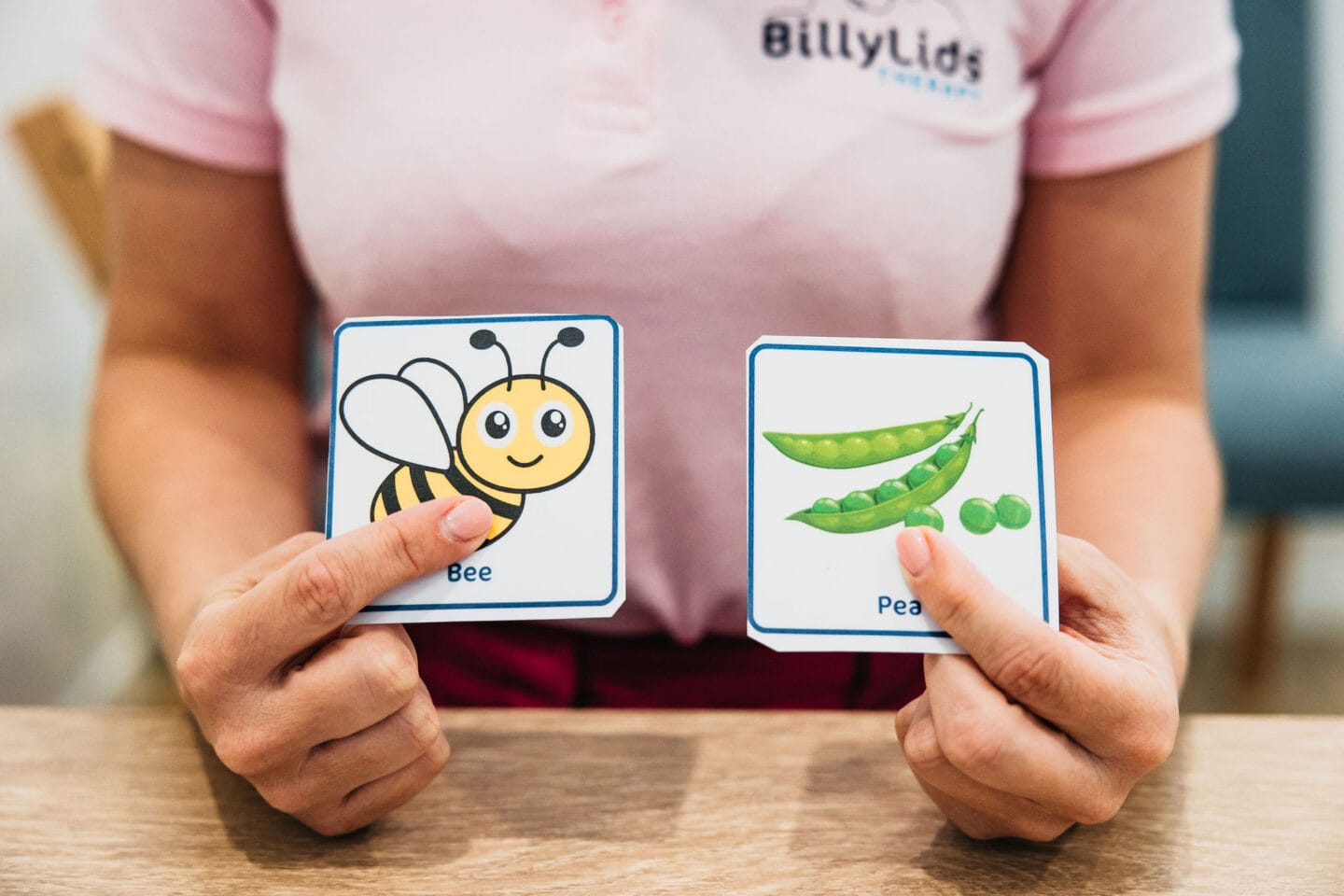
Minimal pairs are pairs of words that differ by only one sound, like “bat” and “pat” or “ring” and “wing.” These small sound changes can completely change the meaning of words, making them important in speech therapy. Speech pathologists use minimal pairs to help children hear and produce the correct sounds, improving their pronunciation and communication. By focusing on these subtle differences, kids can become more aware of how sounds affect the meaning of words and improve their speech clarity.
Minimal pairs are typically categorised into different types based on the phonemes they contrast. These categories include:
- Place: where in the mouth a sound is made
- Manner: how the airflow is shaped or blocked
- Voice: whether or not the vocal cords vibrate when making a sound
Other speech errors can also be targeted such as contrasts with Final Consonant Deletion. For example, a child may say “bee” when they are describing the sound of a car horn. In this case we would use the minimal pairs: “bee” and “beep”.
In speech therapy, minimal pairs are used to help children with specific sound errors. The therapist first identifies the child’s speech difficulties through assessment, then selects word pairs that differ by only one sound, like “ring” and “wing” for a child struggling with “r” and “w” sounds. The child practices these pairs to improve how they hear and say the sounds. Typically, 3 to 5 sets of minimal pairs are used during therapy sessions to make the exercises both challenging and achievable.
Why Are Minimal Pairs Important?
Minimal pairs are essential in speech therapy because they address the core issues of speech: auditory discrimination and articulation. By focusing on minimal pairs, children can improve their ability to hear and produce distinct sounds, which is foundational for clear communication.
Enhancing Auditory Discrimination
Minimal pairs help children learn to tell the difference between similar sounds, which is important for understanding language and following instructions. For example, they can practice hearing the difference between “sip” and “ship.”
Improving Articulation
Children practice making sounds more clearly by focusing on small changes in words. This helps them produce the correct sounds and speak more clearly.
Boosting Confidence and Communication Skills
As children master new sounds, they gain confidence, leading to improved social and academic communication.
Addressing Phonological Processes
Minimal pairs also target sound patterns that may persist beyond typical development, helping correct these errors.
Minimal pairs therapy is particularly effective for addressing these processes. For example, a child who substitutes “f” for “p” (saying “fig” instead of “pig”) can benefit from minimal pairs exercises that contrast these sounds, helping them to recognise and produce the correct phoneme (sound).
Examples of Minimal Pairs
Minimal pairs help children learn sounds by focusing on differences in place, manner, or voice.
- Place: Where the sound is made (e.g., /d/ vs /g/).
- Manner: How the sound is made (e.g., /s/ with smooth airflow vs /t/ with a brief stop).
- Voice: Whether the vocal cords vibrate (e.g., voiced /d/ vs voiceless /t/).
Speech pathologists use these contrasts to target specific sound errors and help children improve their pronunciation.
Supporting your child’s Speech Therapy with Minimal Pairs at home
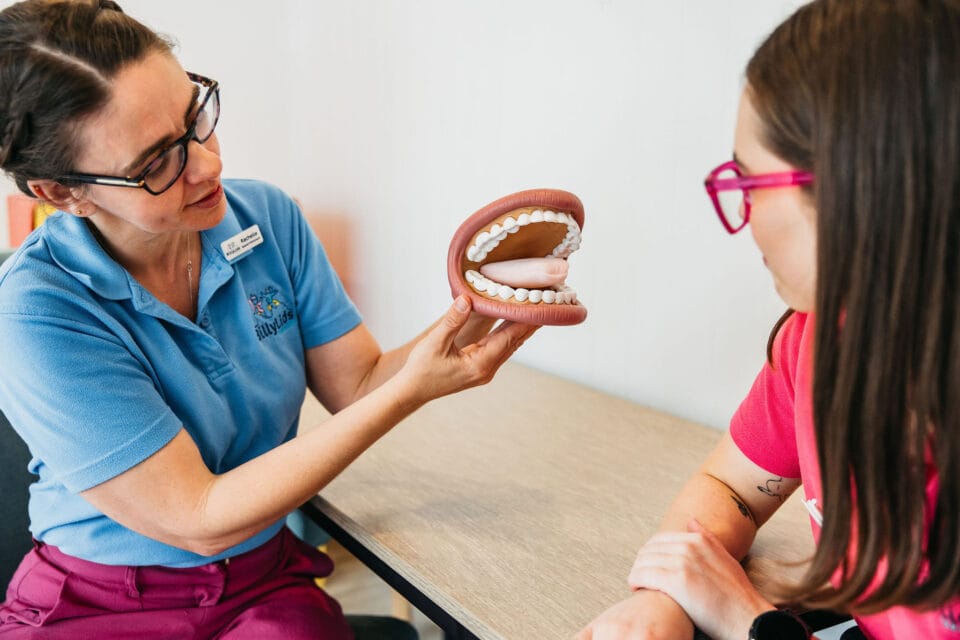
Minimal pairs are a powerful tool in speech therapy, helping children improve their pronunciation and listening skills. As a parent, you can play an active role in reinforcing these lessons at home. Here’s how:
1. Create a Routine
Set aside 5-10 minutes each day for minimal pairs practice. Consistency helps reinforce new sounds.
2. Make It Fun
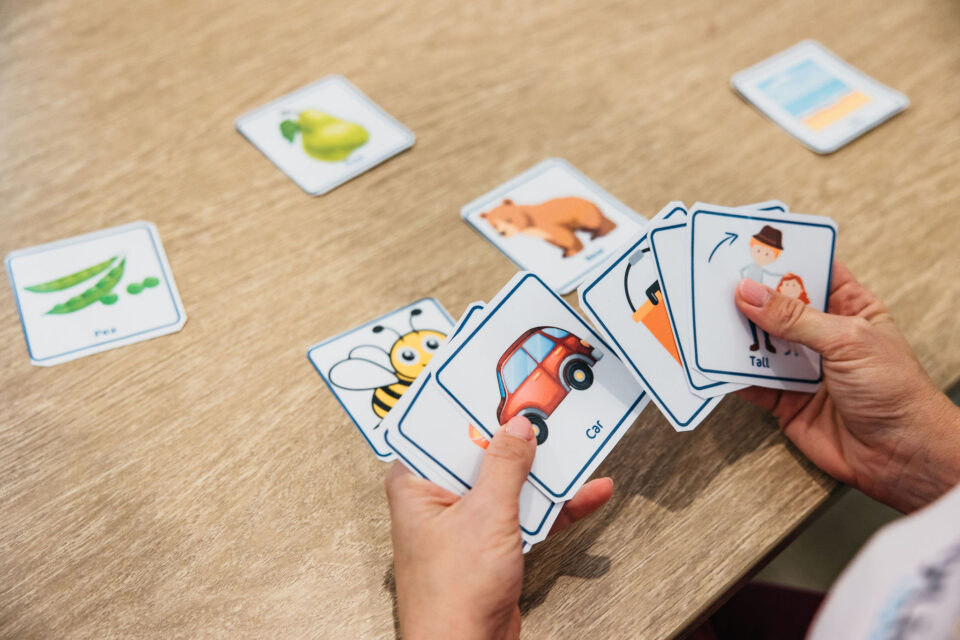
Turn practice into a game using cards or matching objects, and make activities engaging during everyday routines.
3. Use Visuals
Show pictures for words like “ring” and “wing” to connect sounds with meaning.
4. Games
Turn practice into a game, like matching cards or a treasure hunt with objects representing minimal pairs.
5. Practice During Daily Activities
Incorporate minimal pairs into everyday activities like meal or bedtime, using words like “cup” and “cub.”
6. Positive Reinforcement
Praise and reward your child for progress, boosting their confidence.
By integrating these strategies into your daily routine, you can support your child’s speech therapy journey and help them improve their communication skills more effectively.
Examples of Games to Play Incorporating Minimal Pairs
Practice at home is essential for reinforcing skills learned in therapy and promoting generalisation to everyday environments, such as the home. By engaging in fun, interactive activities like games, children can practice using target sounds in a relaxed and meaningful context, helping them apply these skills more naturally in their daily communication. Below are some examples of games incorporating minimal pairs to make at-home practice both effective and enjoyable.
Memory Match
- Materials: Two sets of minimal pair cards.
- How to Play: Lay the cards face down and take turns flipping them over to find matching pairs, saying the words aloud each time.
- Target Skill: Auditory discrimination and memory.
Sound Scavenger Hunt
- Materials: Objects or pictures of minimal pair words hidden around the house.
- How to Play: Give clues to find an object. Once found, the child says the word and its minimal pair.
- Target Skill: Listening and articulation.
Minimal Pair Bingo
- Materials: Bingo cards with minimal pair pictures.
- How to Play: Call out one word from a pair, and the child covers it if it’s on their card. They must say the word and its pair before marking it.
- Target Skill: Auditory processing and sound production.
Fishing for Sounds
- Materials: Paper fish with minimal pair words written on them, a fishing rod with a magnet (or paperclip).
- How to Play: Attach a paperclip to each fish. Players “fish” for a word and say it out loud, practicing the target sound.
- Variation: Use one word from each pair and have the child guess the contrasting pair.
- Target Skill: Sound awareness and articulation.
Minimal Pair Bowling
- Materials: Plastic bowling pins or blocks with pictures of minimal pairs taped on them.
- How to Play: Set up the pins. When a child knocks one down, they say the word and its pair.
- Target Skill: Speech production in a motivating setting.
Sorting Game
- Materials: Cards with minimal pair words and two boxes/baskets labeled with the sounds (e.g., /g/ and /d/).
- How to Play: The child sorts the words into the correct basket while saying them out loud.
- Target Skill: Categorization and phonemic awareness.
Hopscotch Sounds
- Materials: Chalk or paper squares with minimal pair words written on them.
- How to Play: The child hops to a square, says the word, and then hops to its pair.
- Target Skill: Speech production in a physical activity.
Fly Swatter Game
- Materials: A fly swatter, minimal pair picture cards or words spread out on a table or stuck to the wall.
- How to Play:
- Call out one word from a minimal pair (e.g., “goat”).
- The child finds the corresponding picture or word on the table/wall and swats it with the fly swatter while saying the word.
- After swatting, they say the contrasting pair aloud (e.g., “goat/boat”).
- Variation: Use a timer to see how many they can swat and say correctly within a set time.
- Target Skill: Quick auditory processing and speech production combined with a fun motor activity.
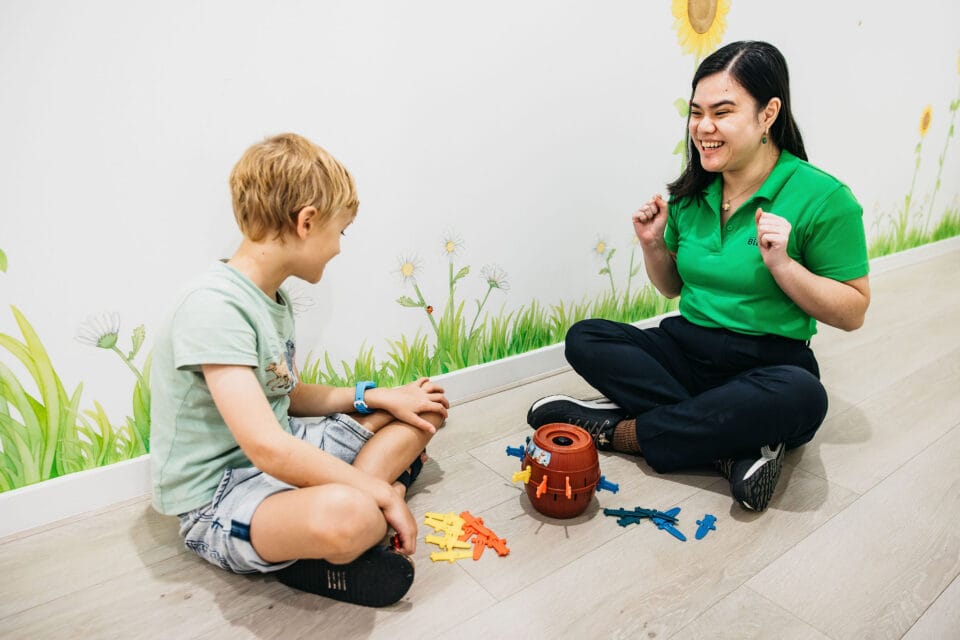
Hidden Picture Sword Challenge with Pop Up Pirate
- How to Play:
- Attach minimal pair pictures (e.g., goat/boat, duck/guck) to the underside of each sword.
- Players take turns selecting a sword and saying the word on the picture they reveal.
- After saying the word, they must try to identify its minimal pair (e.g., if the picture is “goat,” they say “boat”).
- If they say both words correctly, they can insert the sword into the barrel.
- The game continues until the pirate pops up!
- Variation: Include a special “bonus sword” with a tricky pair (e.g., tricky sounds like /th/ or /sh/) that earns an extra turn if said correctly.
Target Skill: Articulation practice, and auditory discrimination.
Examples of minimal pairs:
Place
Contrast in the place or positioning of the articulators of particular sounds. For each of these word pairs, both phonemes (sounds) share the same manner and voice, but differ in their placement of production.
Minimal pairs:
/th/ → /f/ Fricative simplification
/r/ → /w/ Gliding
/l/ → /w/ Gliding
/k/ → /t/ Fronting or Backing
/g/ → /d/ Fronting or Backing
/s/ → /sh/ Palatalisation or Depalatalisation
Minimal Pair /th/ → /f/ Fricative simplification
Word list
Three → Free; Thirst → First; Thin → Fin; Thorn → Fawn; Thor → Four; Thought → Fort; Thread → Fred; Ruth → Roof; Wreath → Reef; With → Wiff; Oath → Oaf.
Free Downloads
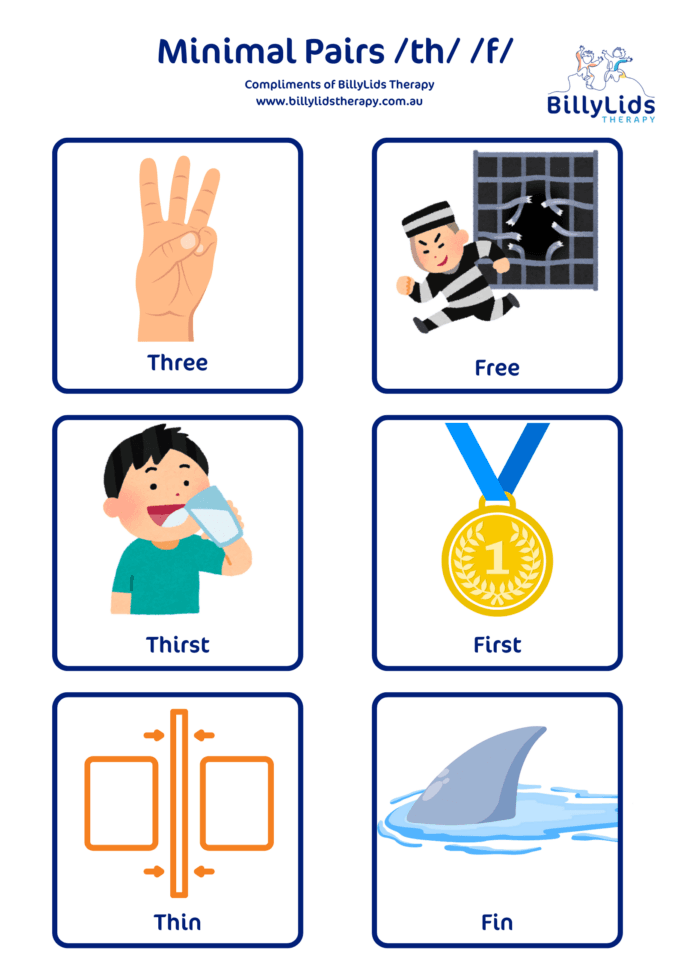
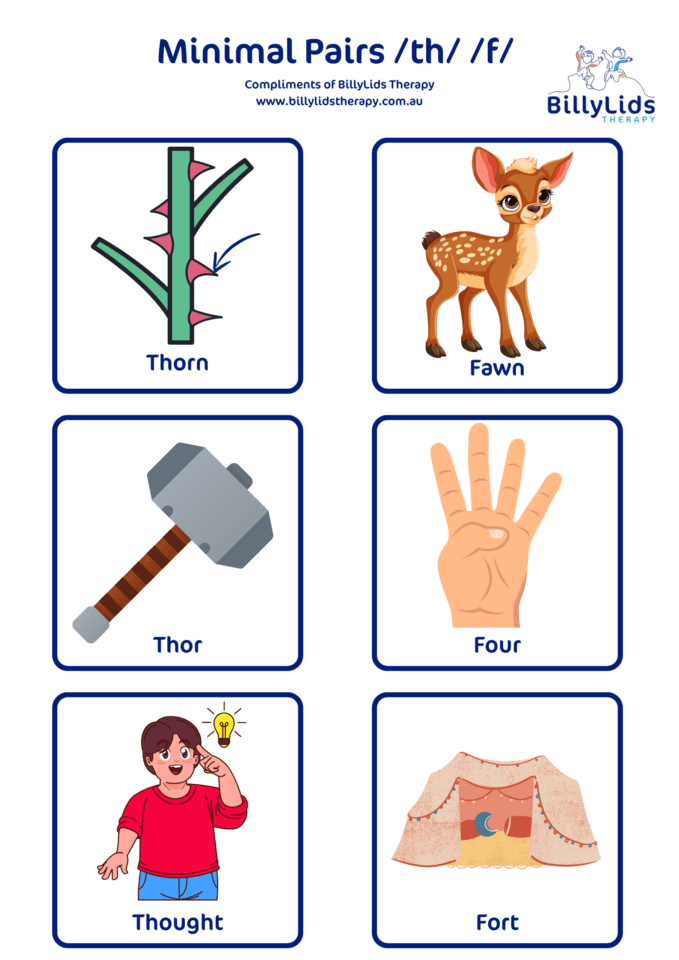
Download th – f minimal pairs here
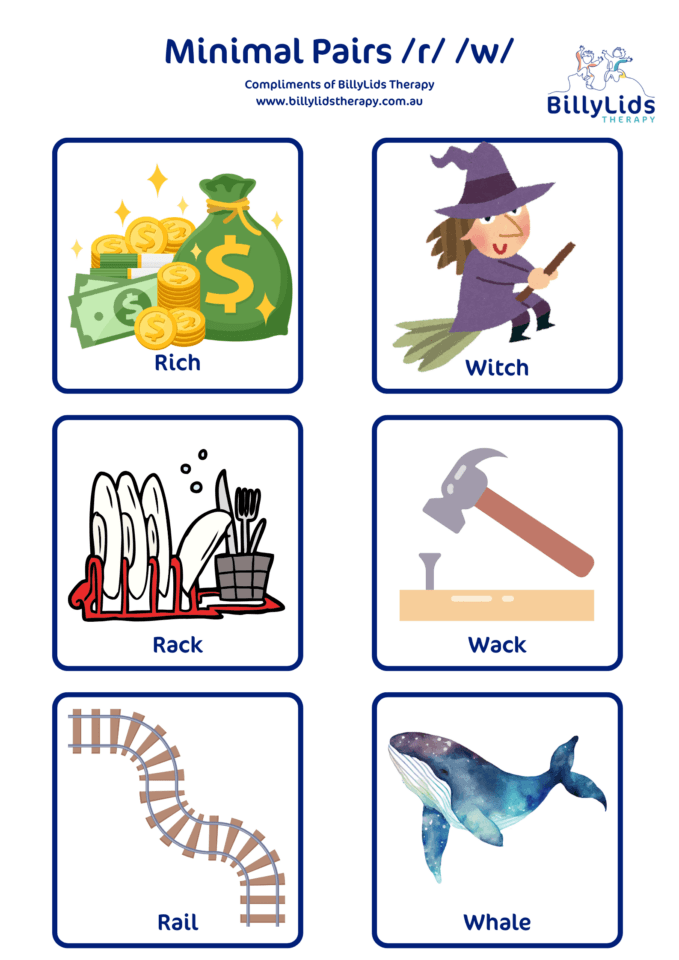
Minimal Pair /r/ → /w/ Gliding
Word List
Rich → Witch; Rack → Wack; Rail → Whale; Read → Weed; Ripe → Wipe; Ride → Wide; Rink → Wink; Reel → Wheel; Write → White; Red → Wed; Ring → Wing; Rock → Wok; Rake → Wake; Run → One; Rag → Wag.
Free Downloads
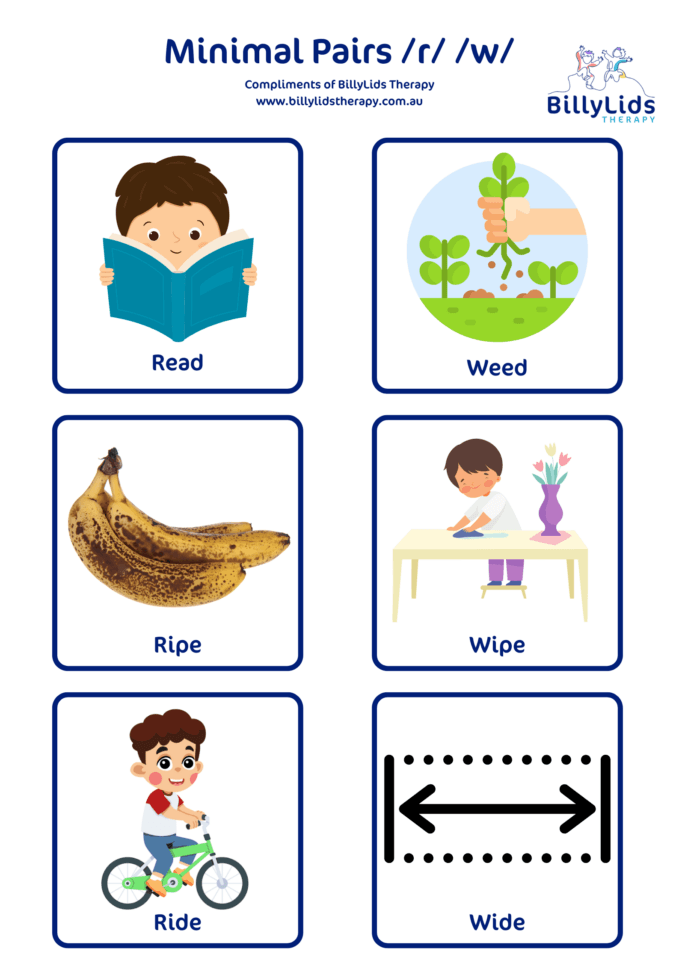
Download r – w minimal pairs here
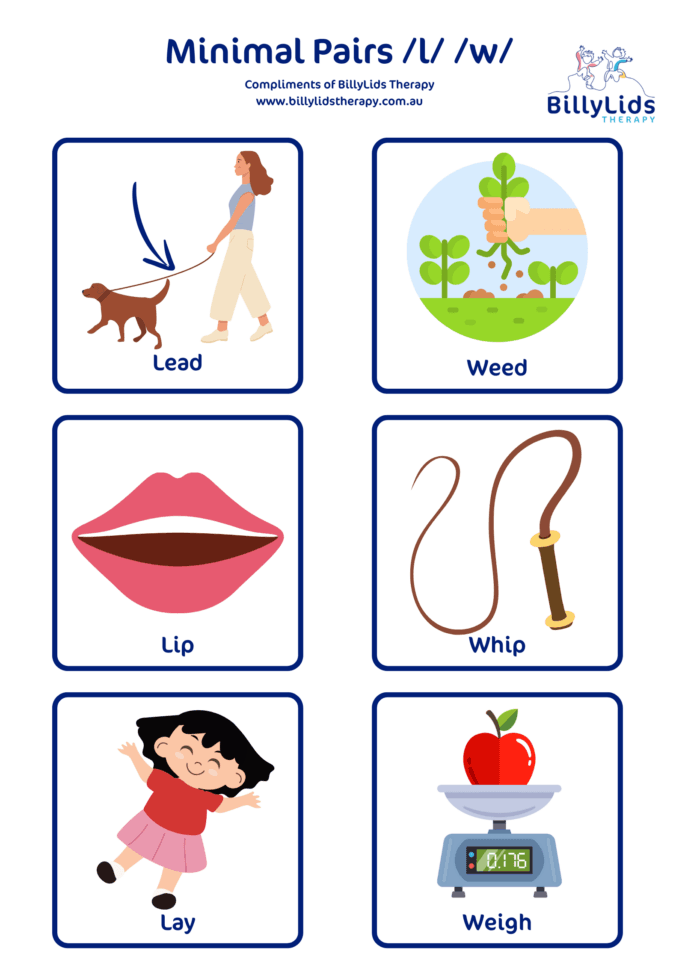
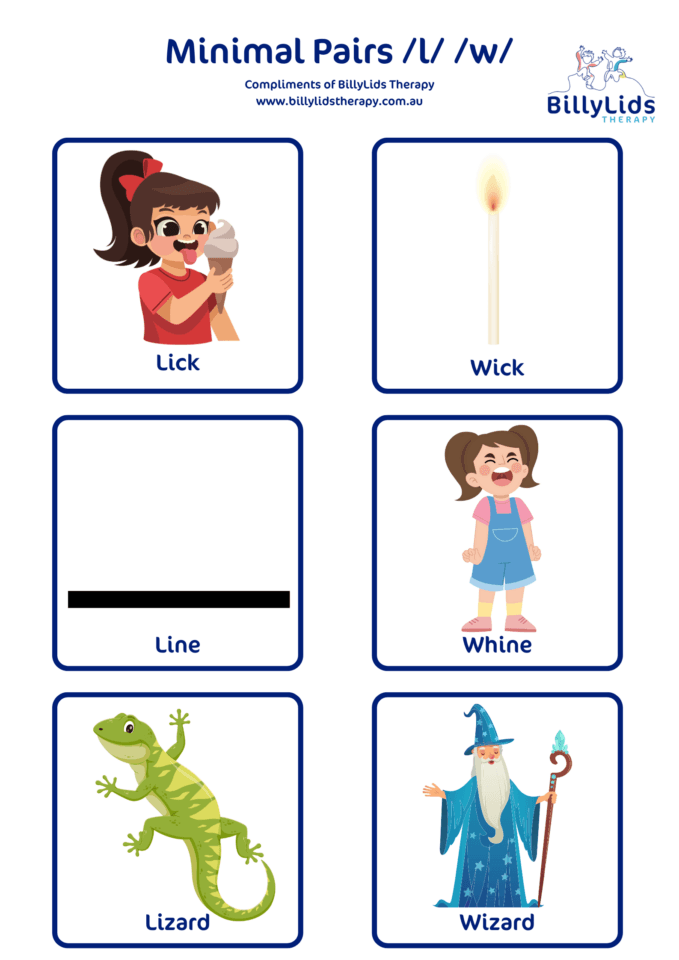
Minimal Pair /l/ → /w/ Gliding
Word List
Lead → Weed; Lip → Whip; Lay → Weigh; Lake → Wake; Link → Wink; Light → White; Lock → Wok; Late → Wait; Leap → Weep; Lick → Wick; Line → Whine; Lizard → Wizard.
Free Downloads
Download l – w minimal pairs here
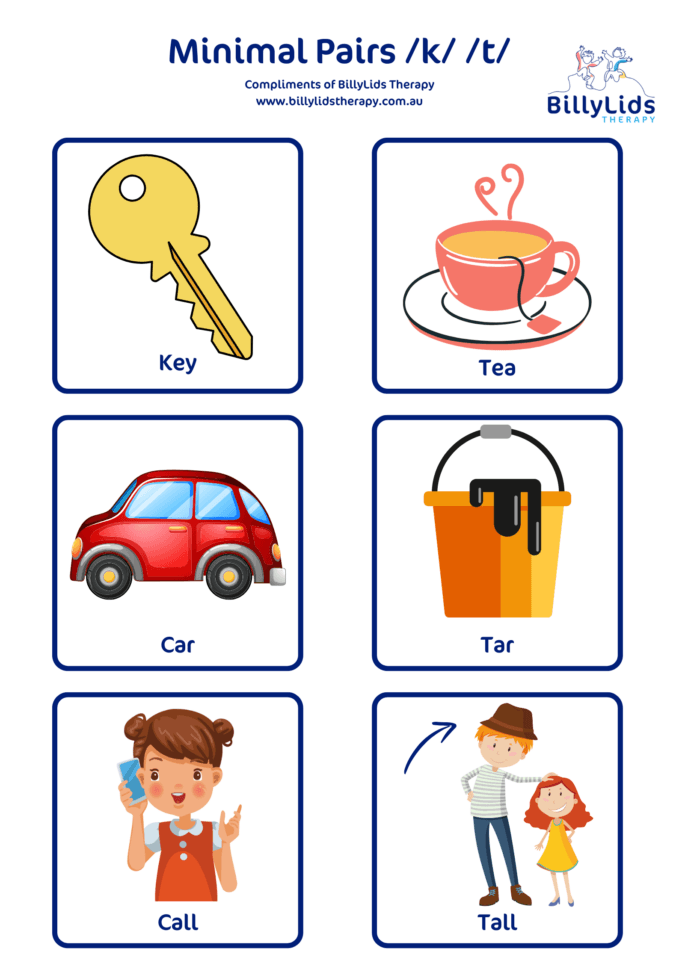
Minimal Pair /k/ → /t/ Fronting or Backing
Word List
Key → Tea; Car → Tar; Call → Tall; Cape → Tape; Kick → Tick; Core → Tore; Cot → Tot; Cub → Tub; Cap → Tap; Cool → Tool; Cab → Tab; Kite → Tight; Kale → Tail; Coast → Toast; Coffee → Toffee.
Free Downloads
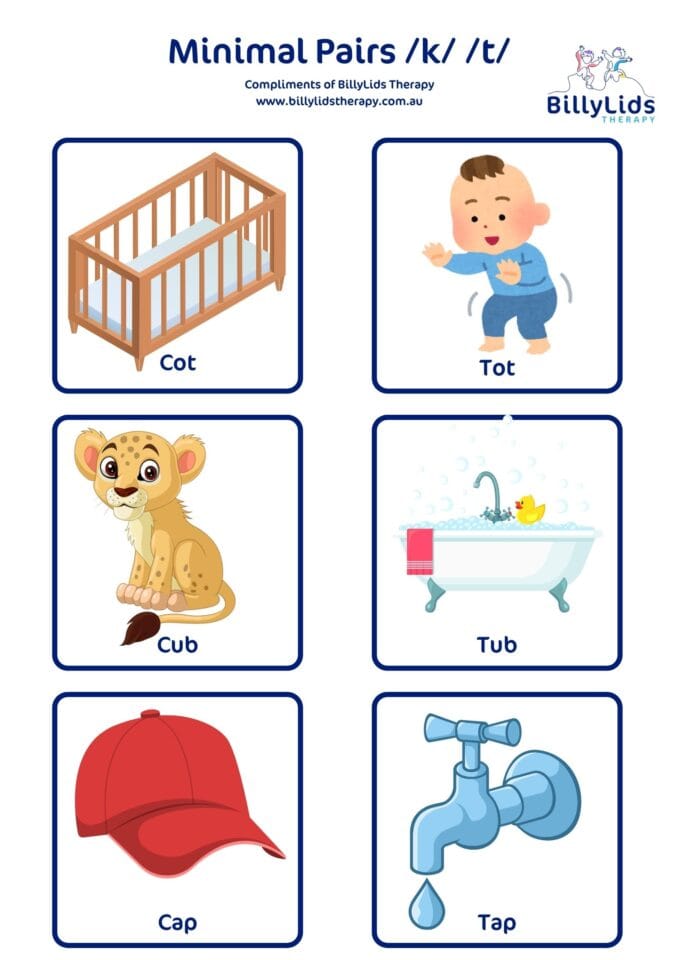
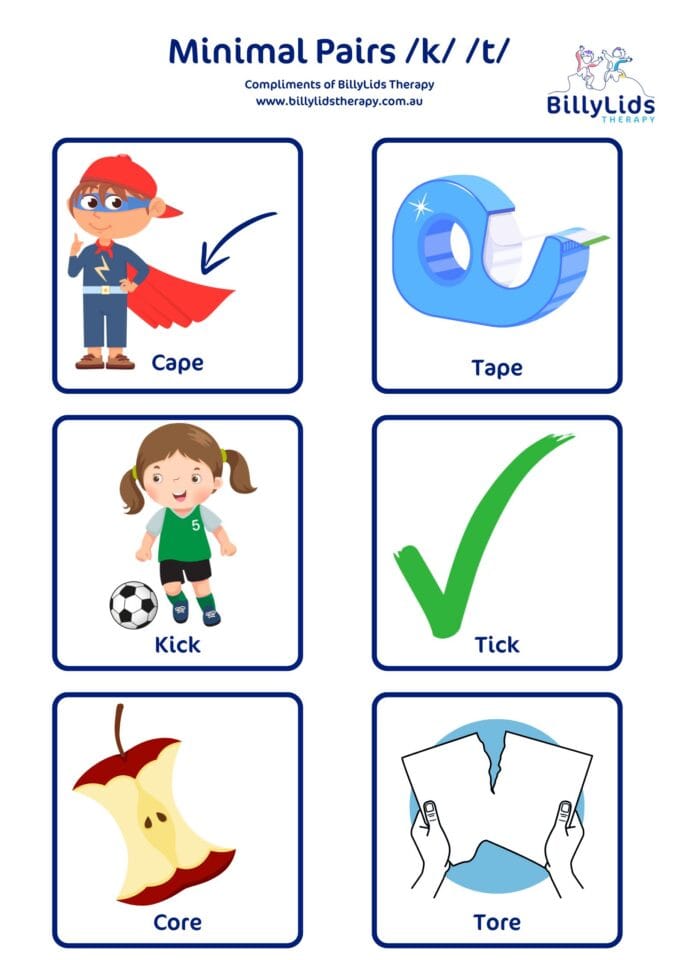
Download k – t minimal pairs here
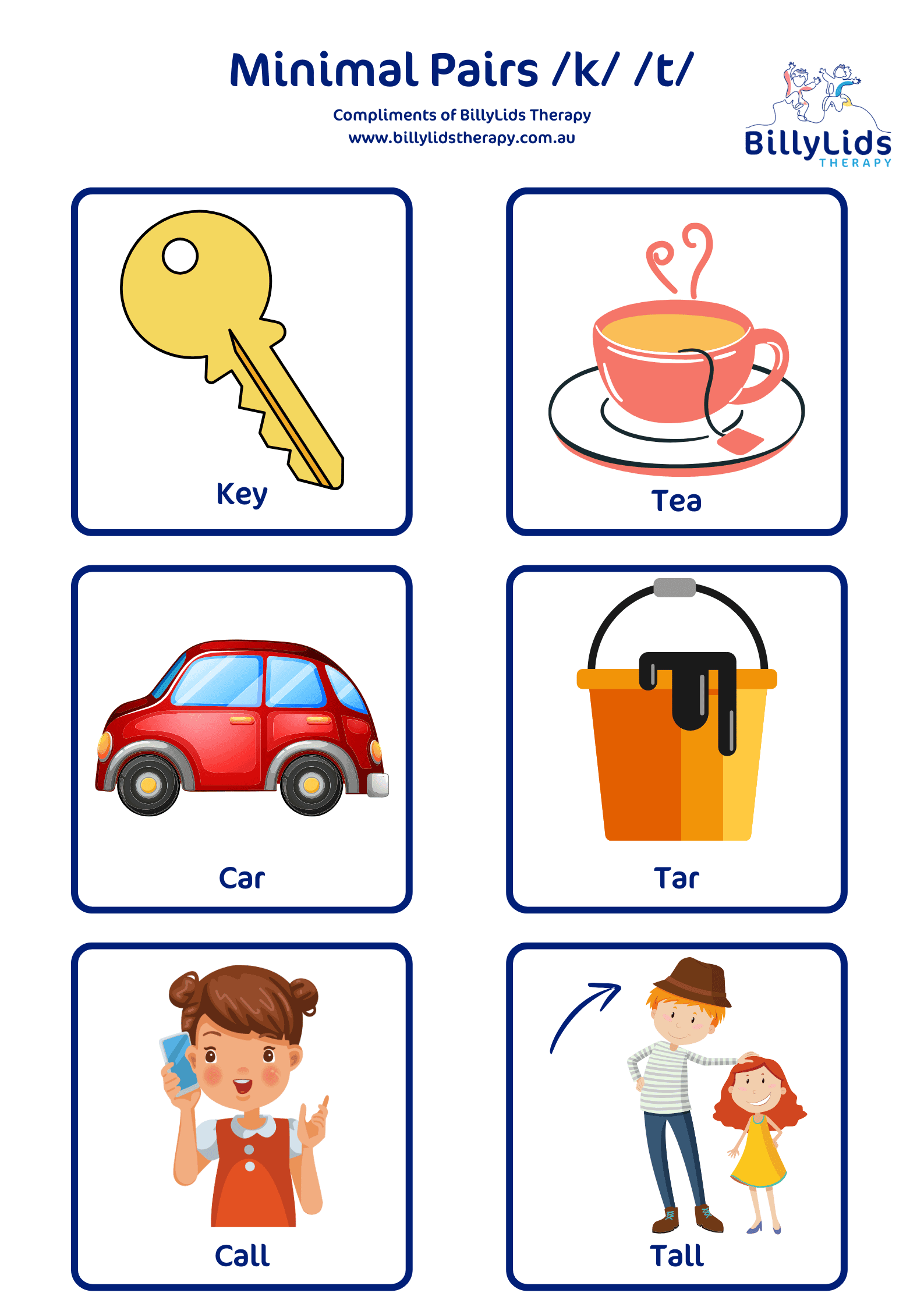
Minimal Pair /g/ → /d/ Fronting or Backing
Word List
Got → Dot; Gear → Deer; Go → Dough; Guy → Dye; Gate → Date; Game → Dame; Gown → Down; Gust → Dust; Gig → Dig.
Free Downloads
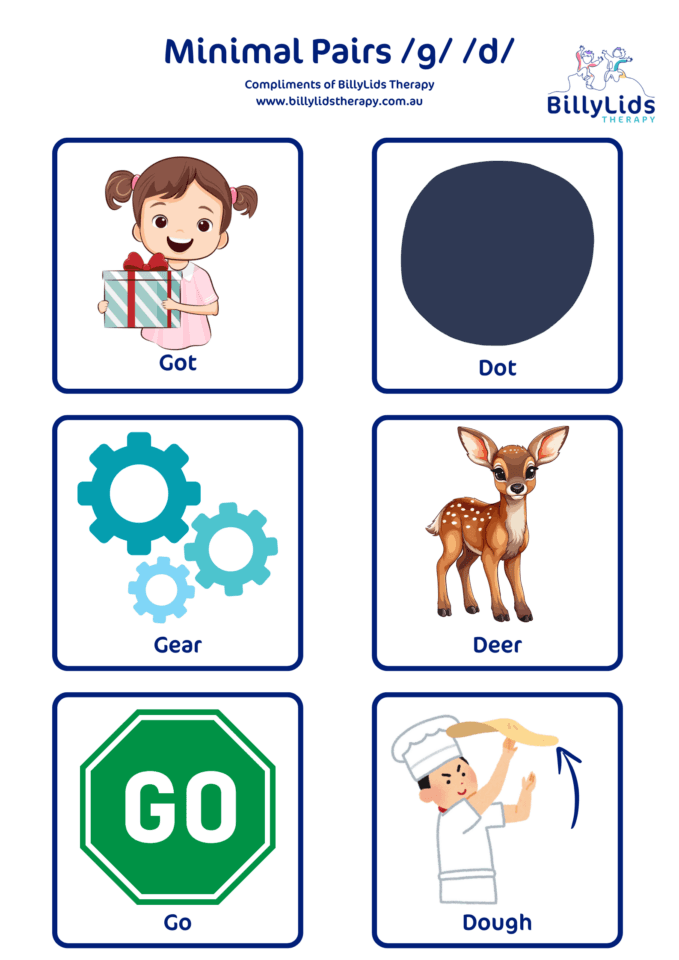
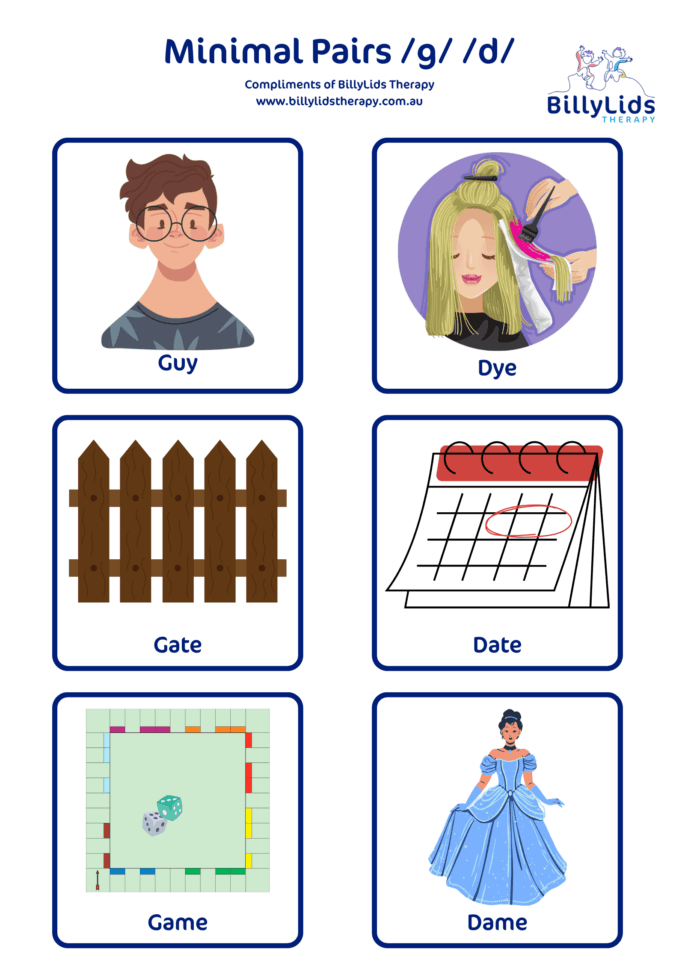
Download g – d minimal pairs here
Minimal Pair /s/ → /sh/ Palatisation
Palatalisation is a process where children replace a sound made with the front of the mouth, like “s,” with a sound made further back near the roof of the mouth, like “sh.” For example, they might say “shun” instead of “sun.”
Depalatalisation is a process where children replace a sound made near the roof of the mouth, like “sh,” with a sound made further forward in the mouth, like “s.” For example, they might say “sun” instead of “shun.”
Word List
Sell → Shell; Save → Shave; Sour → Shower; Sue → Show; Saw → Shore; Sip → Ship; Seat → Sheet; Sack → Shack; Sock → Shock; Sigh → Shy; See → She; Sew → Show.
Free Downloads
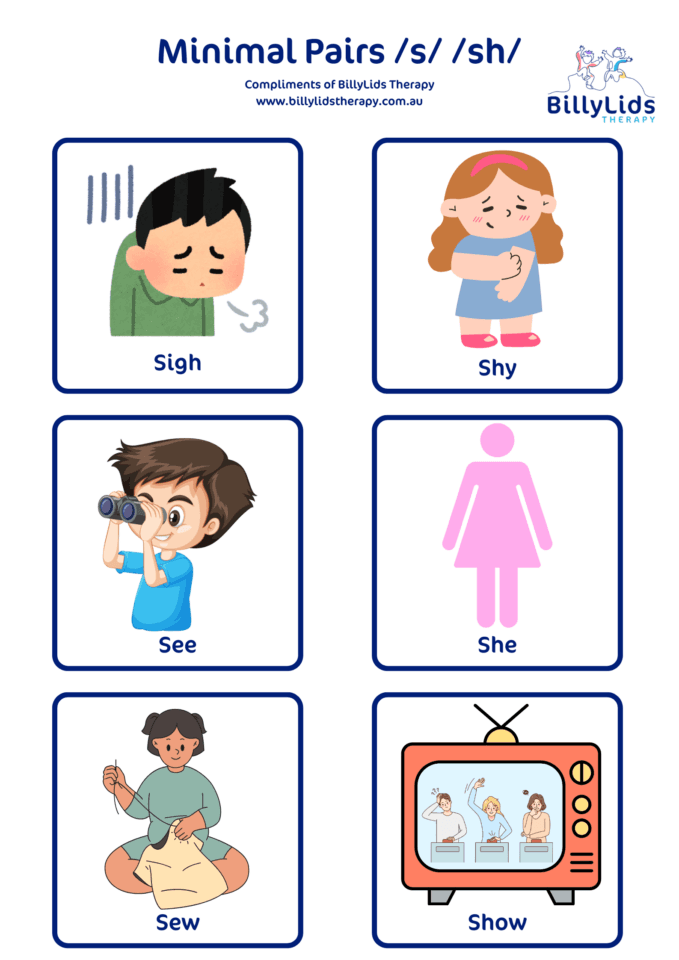
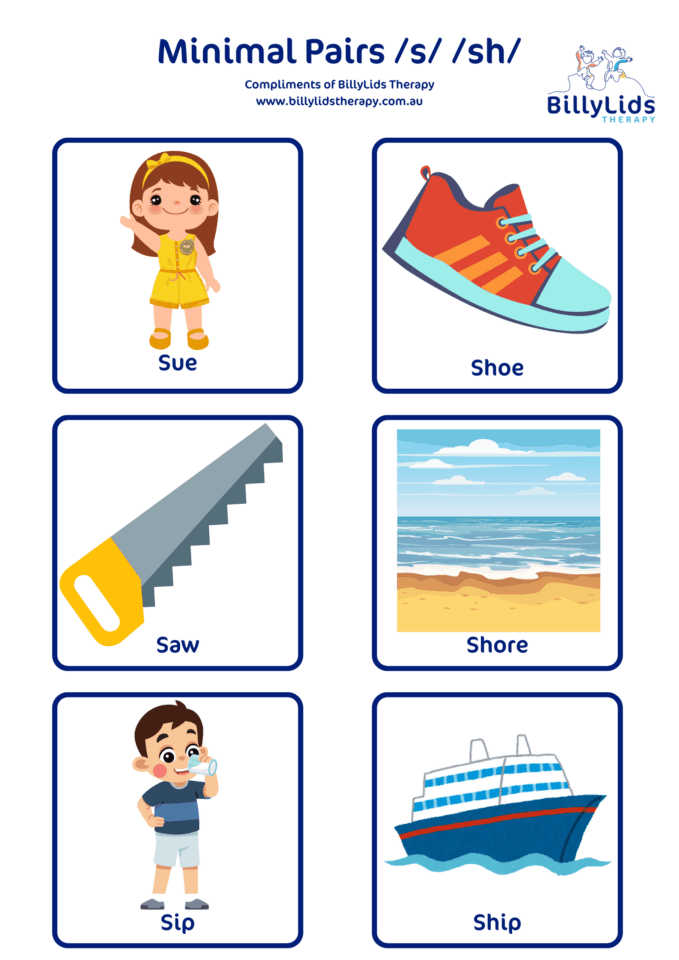
Download s – sh minimal pairs here
Manner
Contrast in the manner of particular sounds. For each of these word pairs, both phonemes share the same place and voice, but differ in their manner of production.
Manner Minimal Pairs
/ch/ → /sh/ Affrication or Deaffrication
/s/ → /p/ Stopping
/v/ → /b/ Stopping
Minimal Pair /ch/ → /sh/ Stopping
Word List
Initial sound:
Chew → Shoe; Chip → Ship; Chop → Shop; Cheep → Sheep; Chair → Share; Chin → Shin; Cheer → Shear; Chatter → Shatter; Chore → Shore.
Final Sound:
Watch → Wash; Witch → Wish; Cash → Catch.
Free Downloads
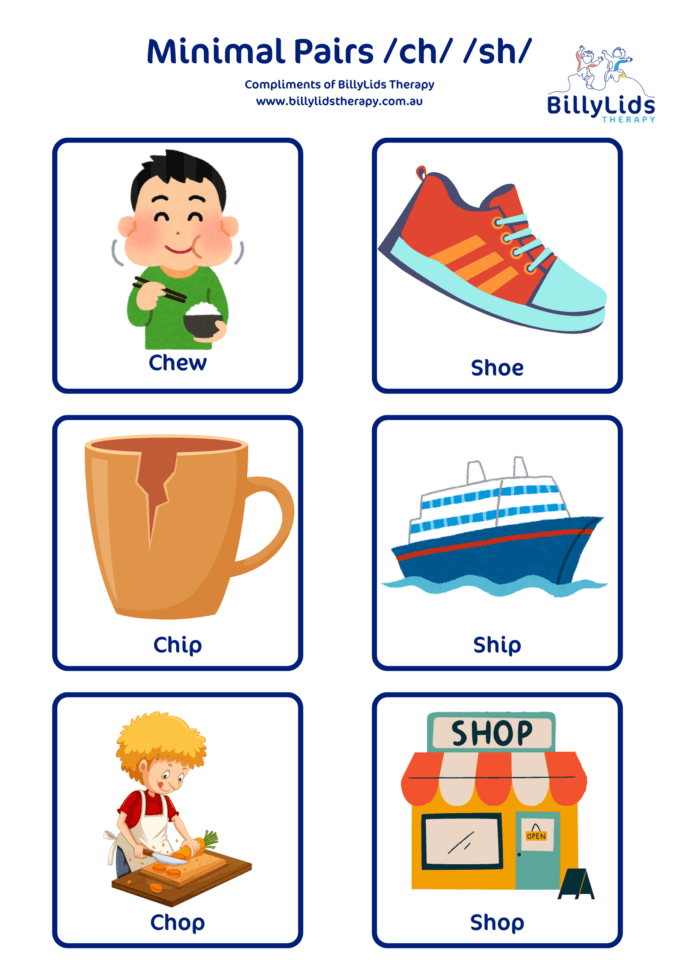
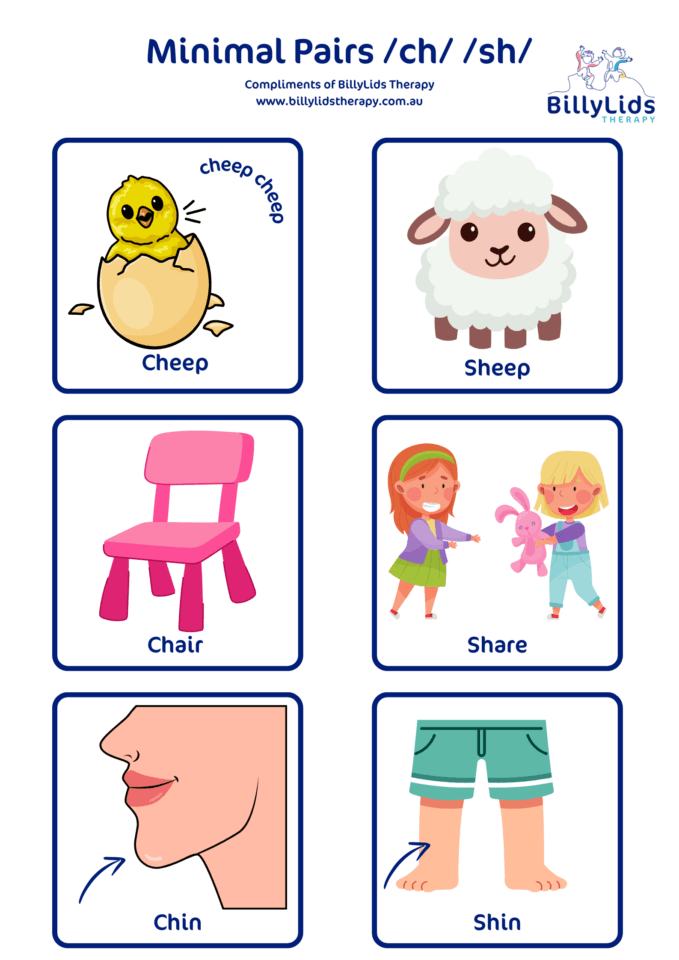
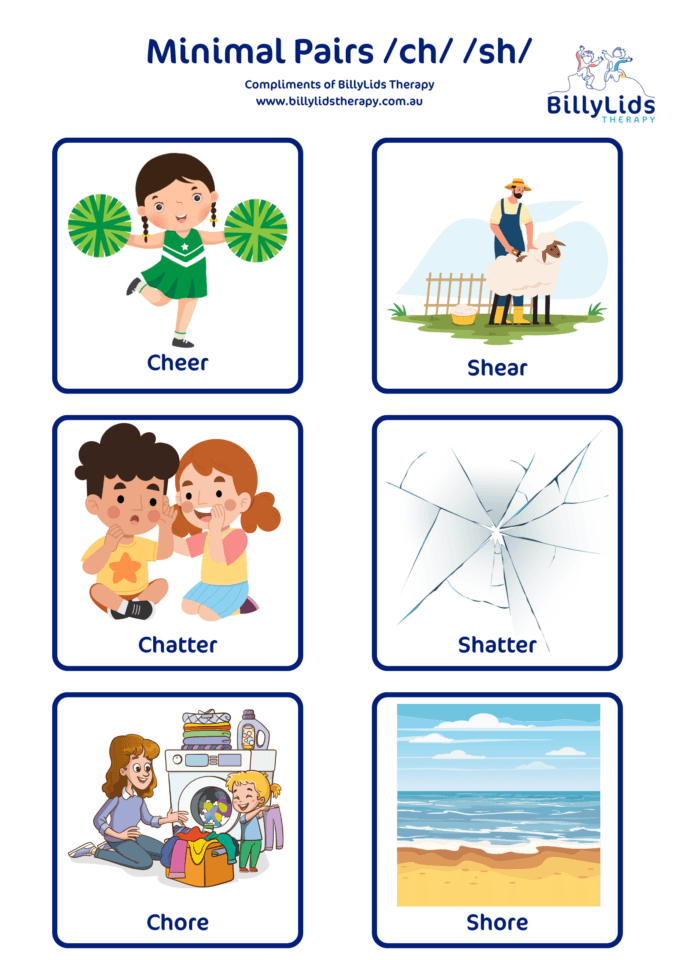
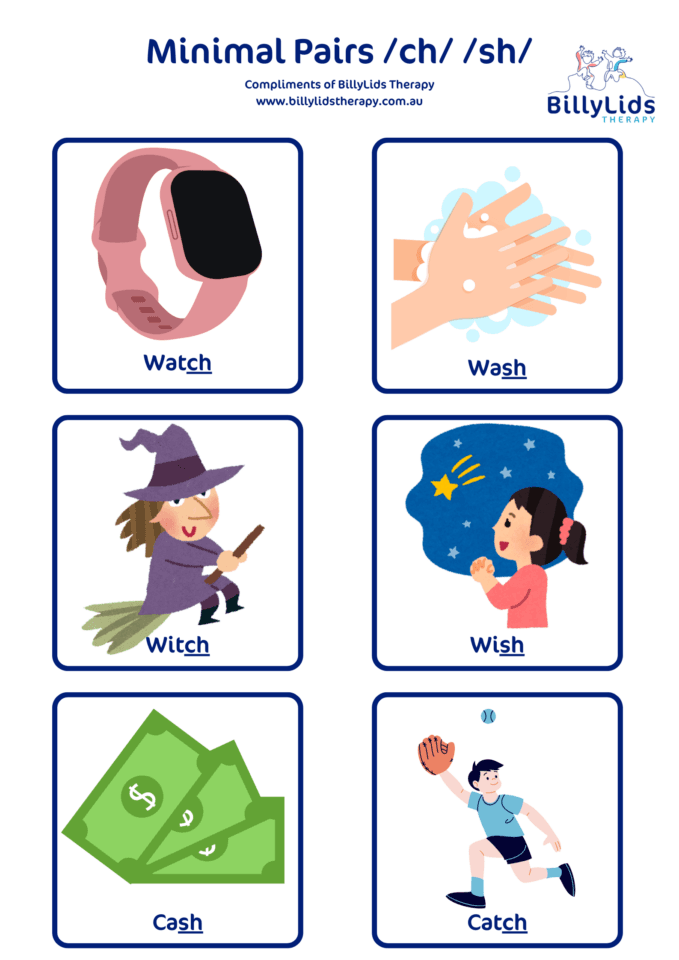
Download ch – sh minimal pairs here
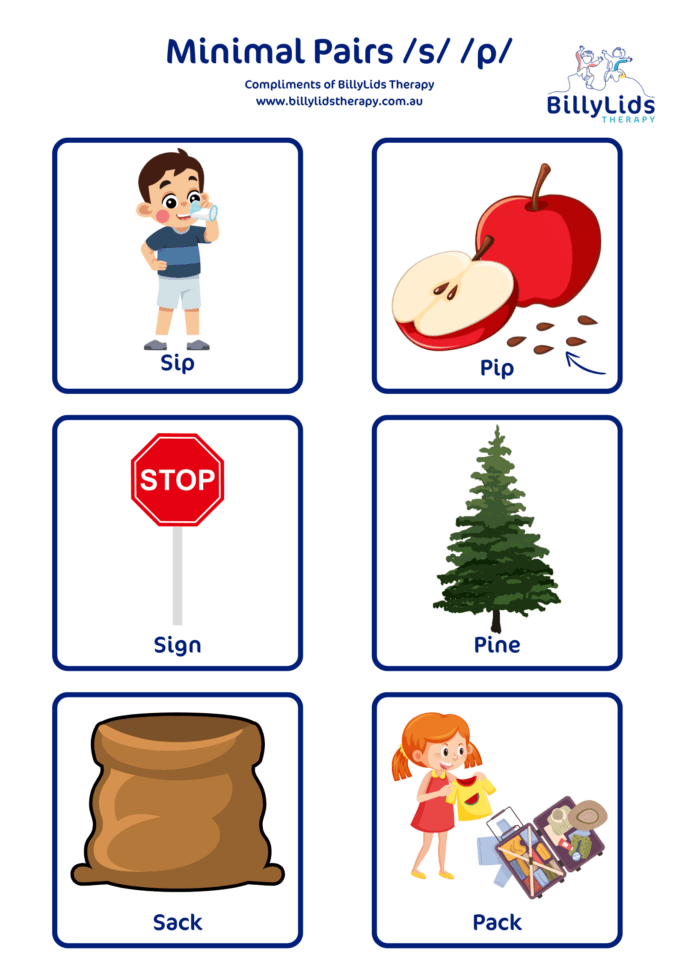
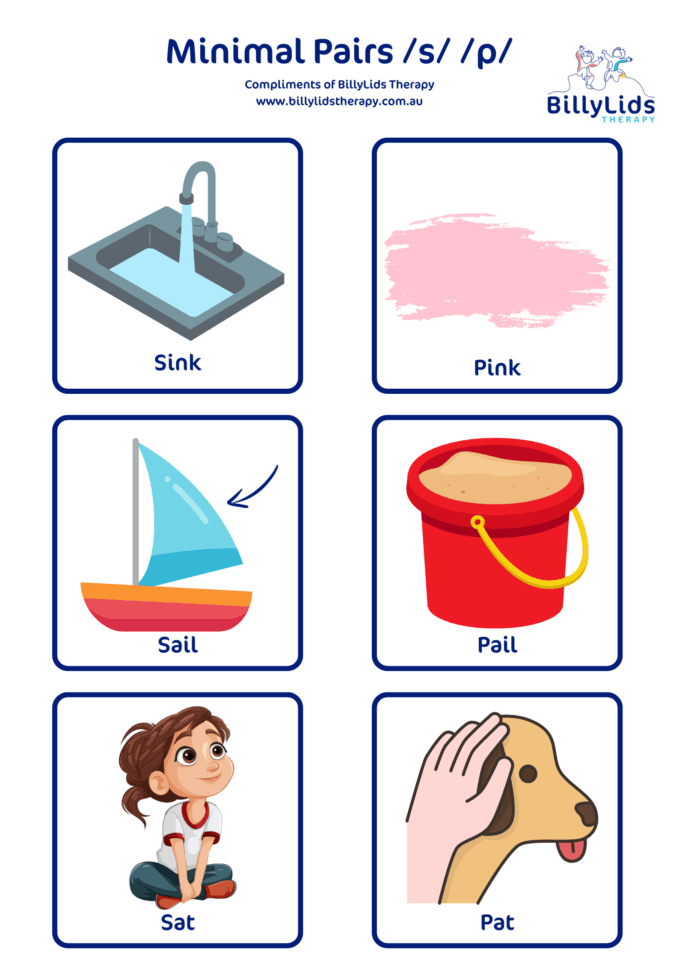
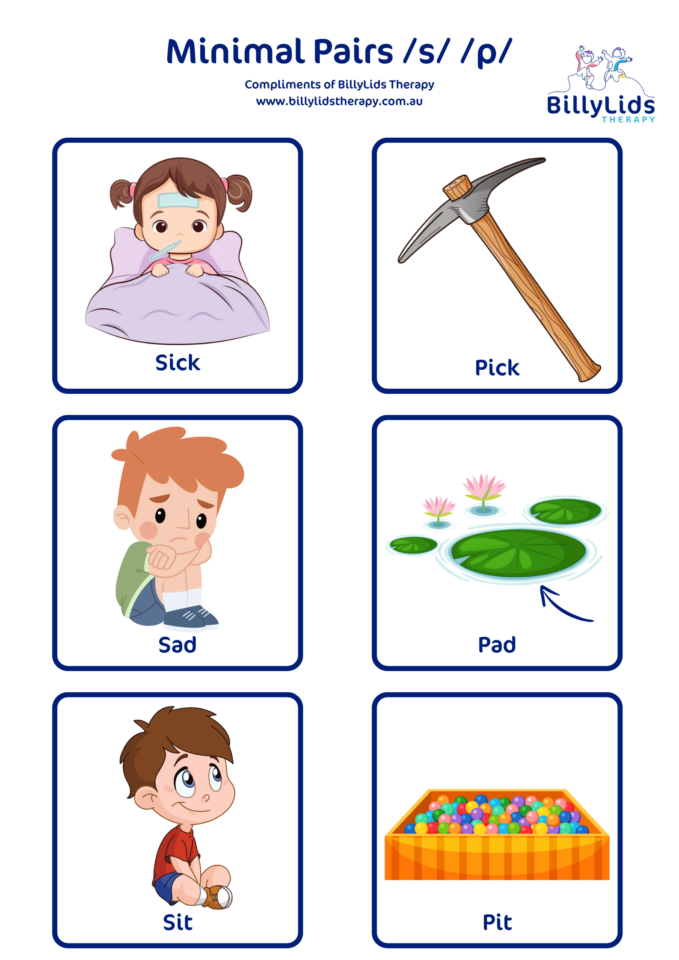
Minimal Pair /s/ → /p/ Stopping
Word List
Sea → Pea; Sigh → Pie; Saw → Paw; Sip → Pip; Sign → Pine; Sack → Pack; Sink → Pink; Sail → Pail; Sat → Pat; Sick → Pick; Sad → Pad; Sit → Pit.
Free Downloads
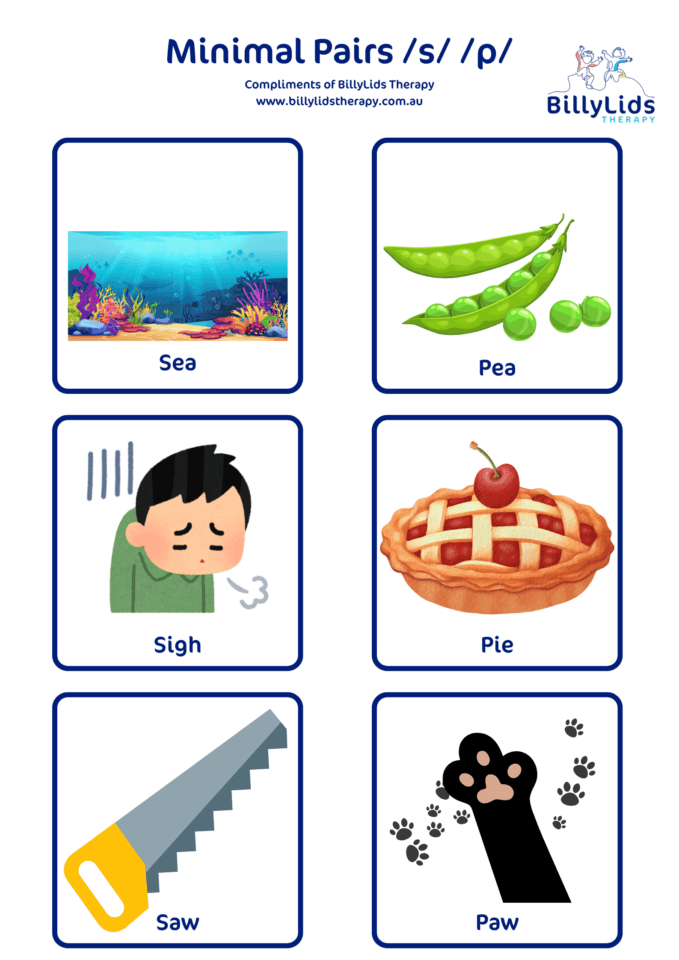
Download s – p minimal pairs here
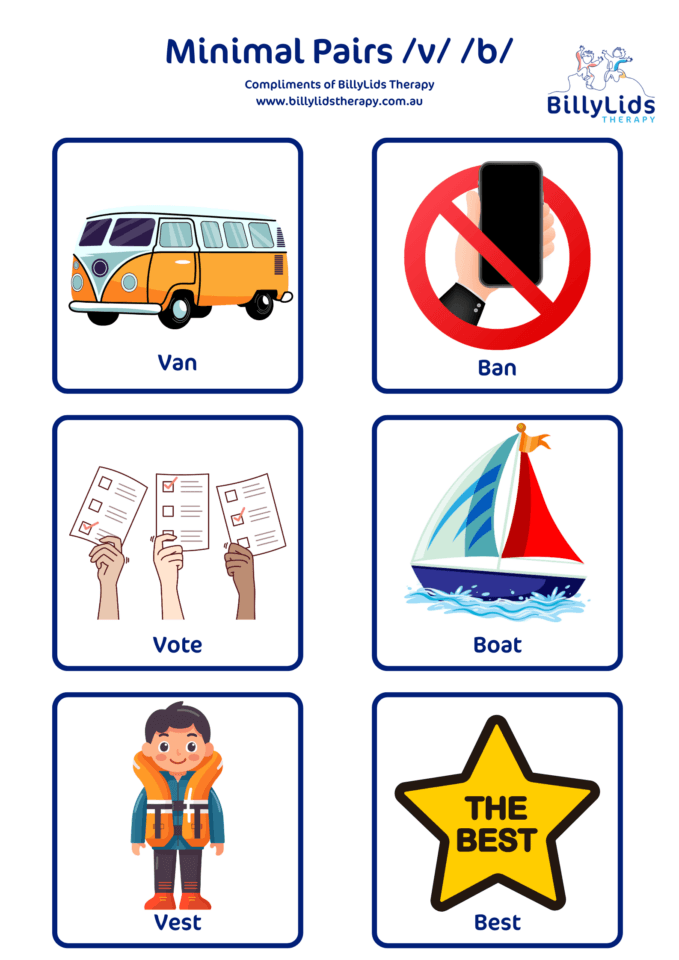
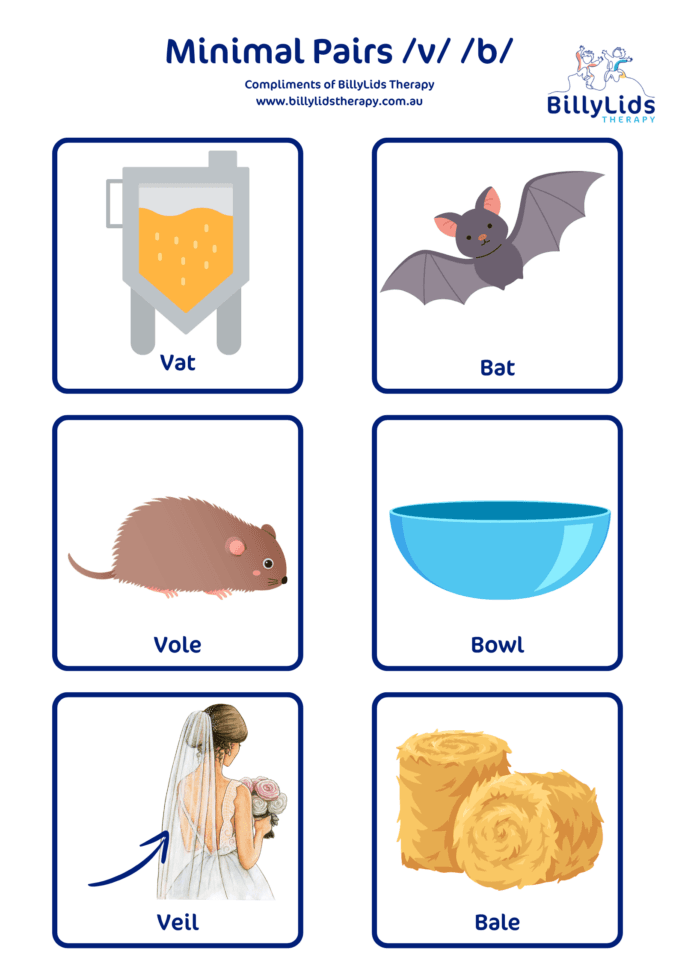
Minimal Pair /v/ → /b/ Stopping
Word List
Van → Ban; Vote → Boat; Vest → Best; V → Bee; Vow → Bow; Vet → Bet; Vat → Bat; Vole → Bowl; Veil → Bale.
Free Downloads
Download v – b minimal pairs here
Voice Minimal Pairs
Contrast in the voicing of particular sounds. For each of these word pairs, both phonemes share the same place and manner, but differ in whether they are voiced or voiceless.
Voice Minimal Pairs:
Devoicing or Voicing
/b/ → /p/
/z/ → /s/
/g/ → /k/
/v/ → /f/
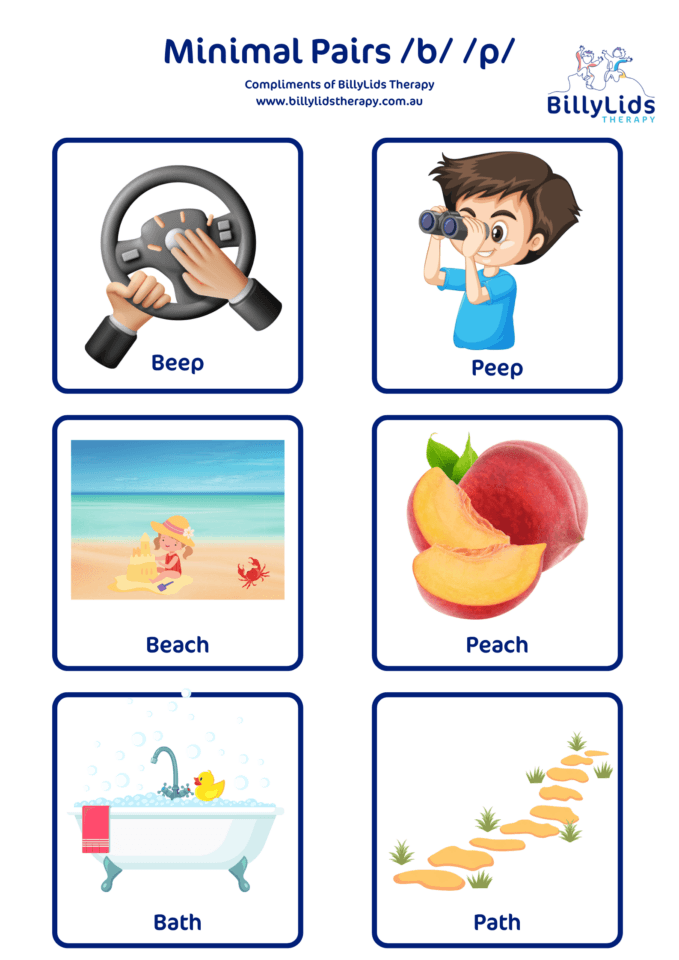
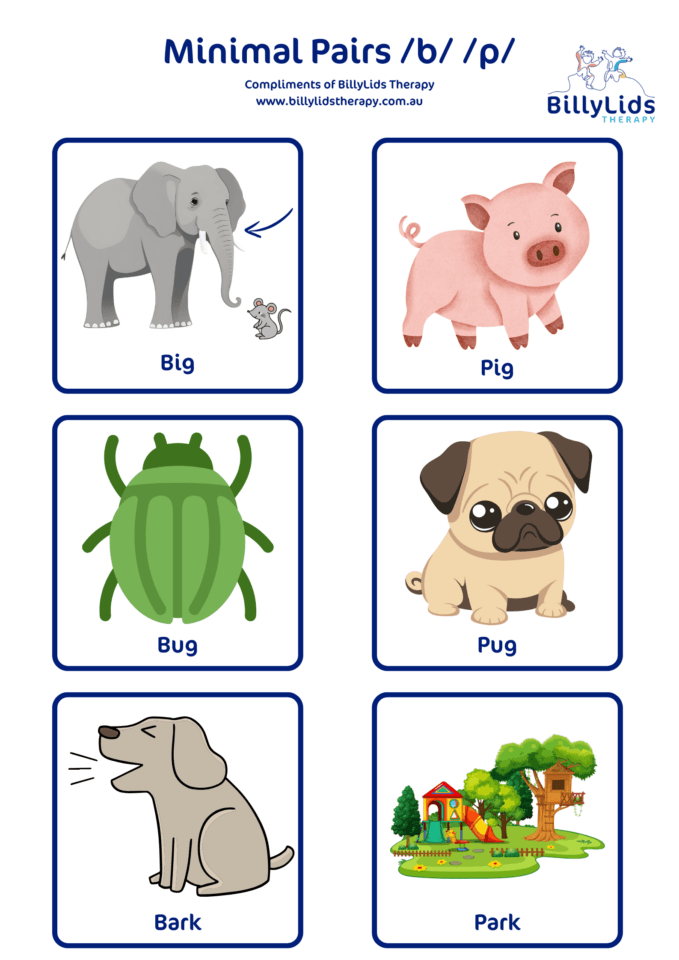
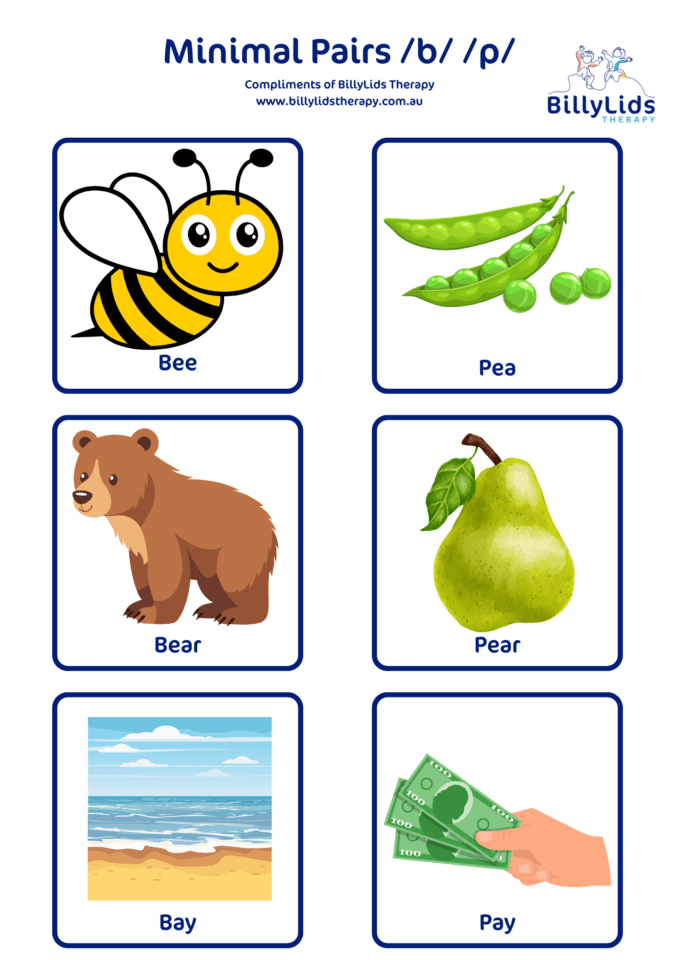
Minimal Pair /b/ → /p/
Word List
Beep → Peep; Beach → Peach; Bath → Path; Big → Pig; Bug → Pug; Bark → Park; Bee → Pea; Bear → Pear; Bay → Pay.
Free Downloads
Download b – p minimal pairs here
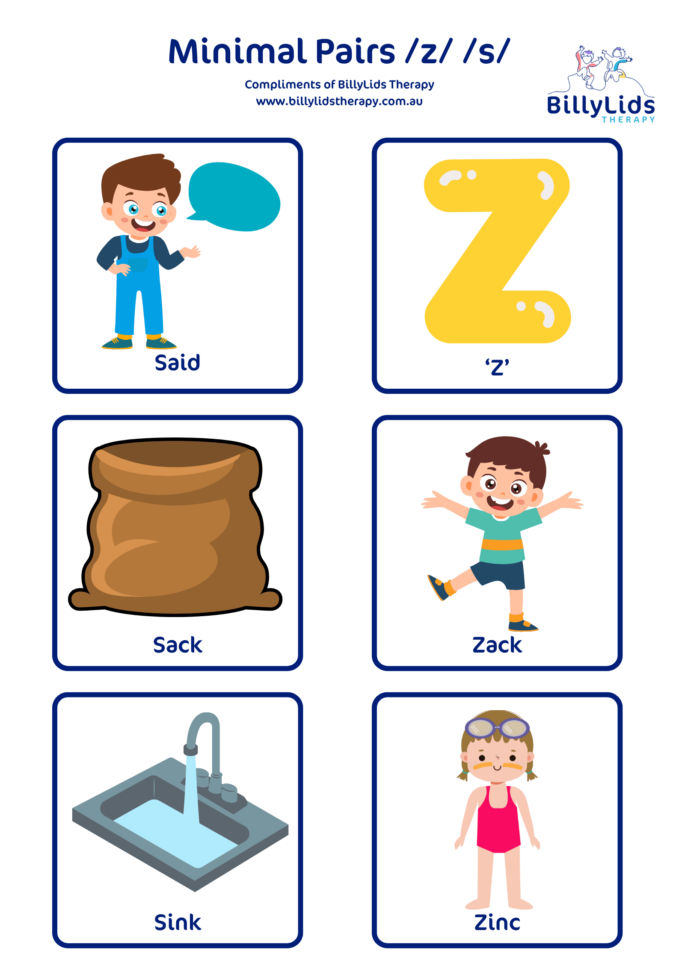
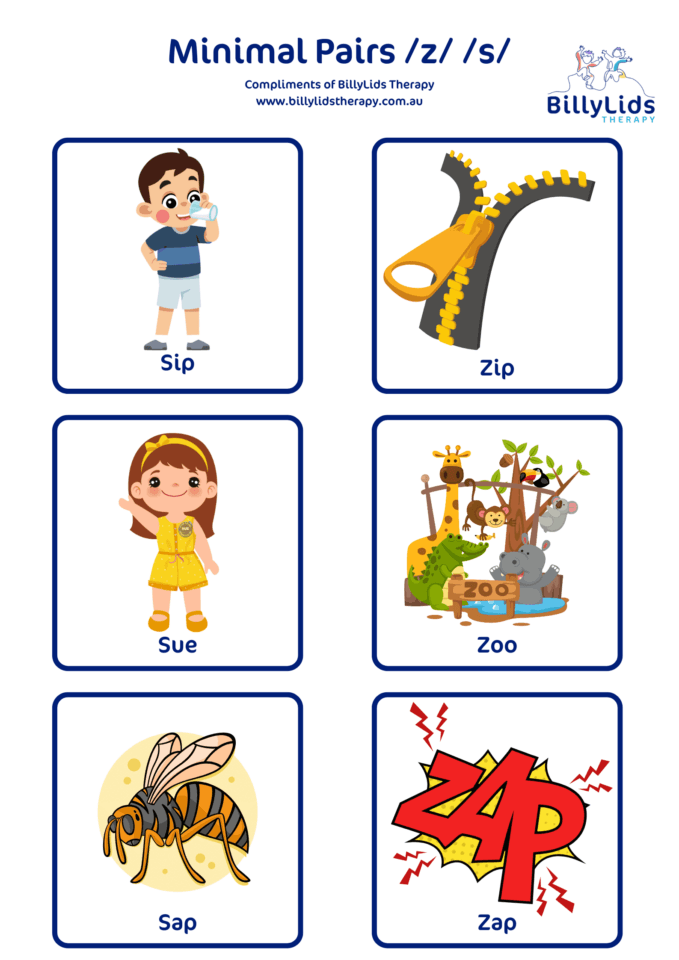
Minimal Pair /z/ → /s/
Word List
Said → ‘Z’; Sack → Zack; Sink → Zinc; Sip → Zip; Sue → Zoo; Sap → Zap.
Free Downloads
Download s – z minimal pairs here
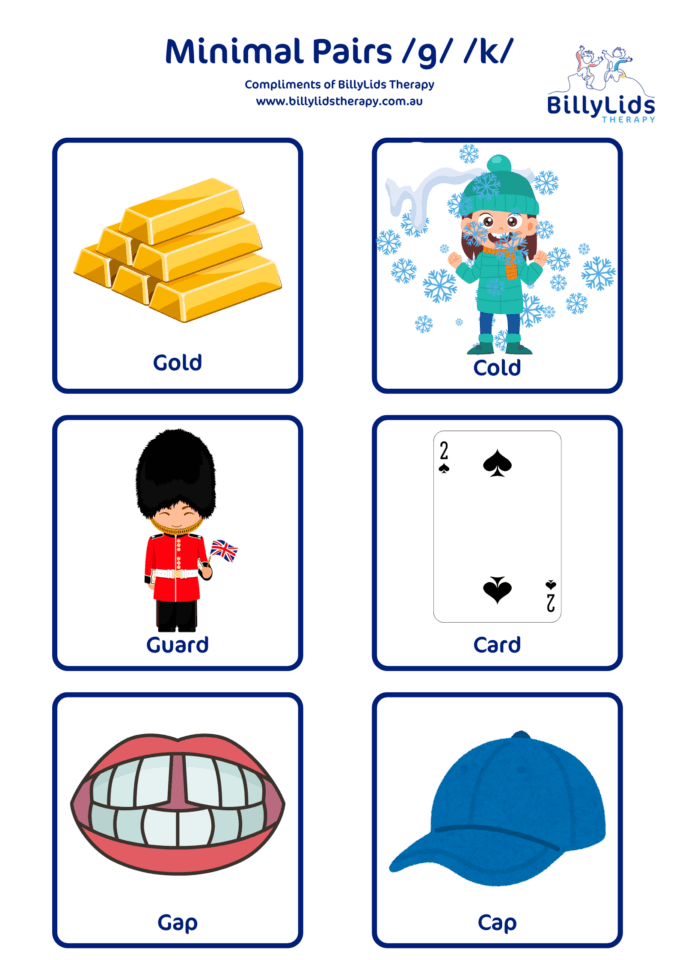
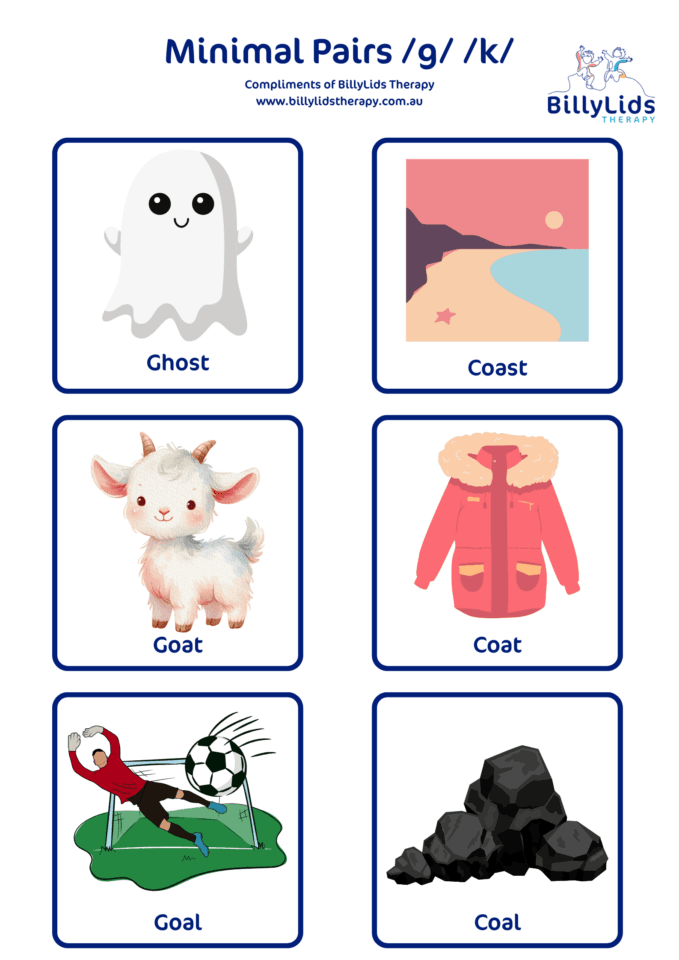
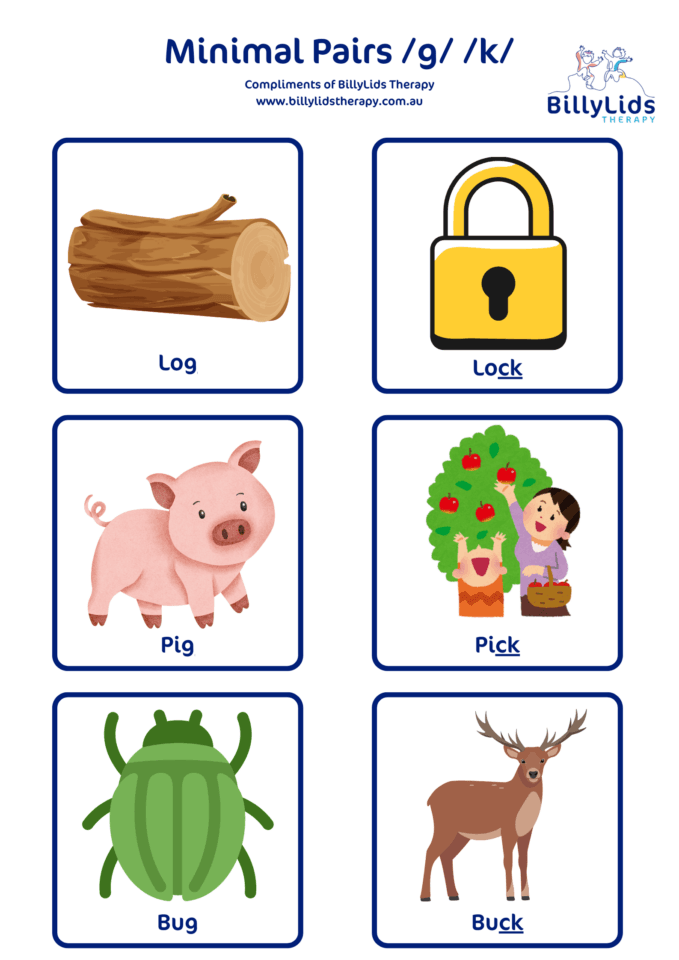
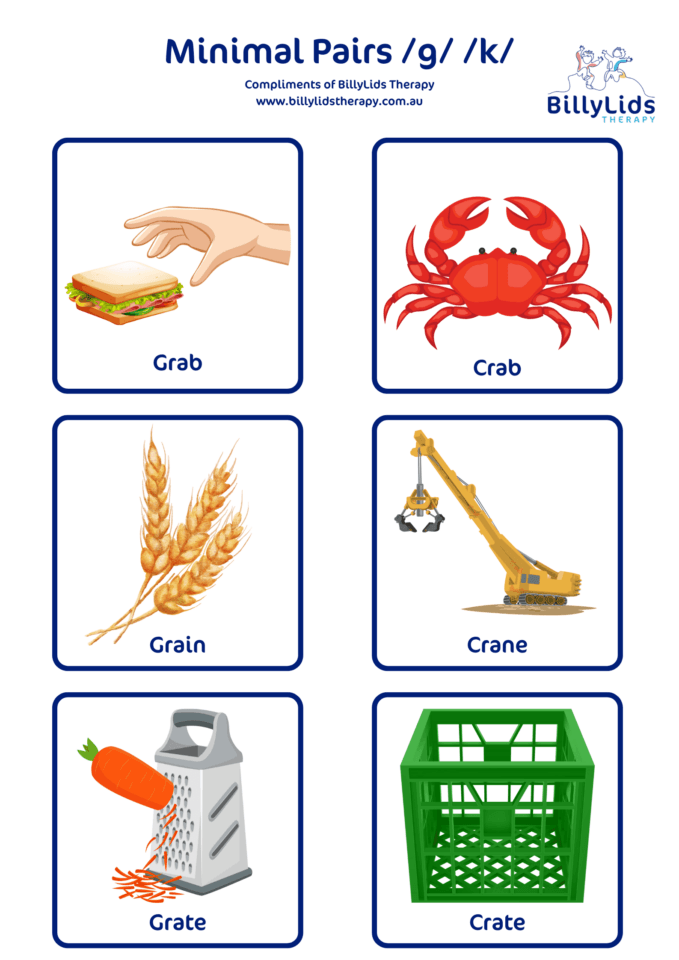
Minimal Pair /g/ → /k/
Word List
Initial Sound:
Gold → Cold; Guard → Card; Gap → Cap; Ghost → Coast; Goat → Coat; Goal → Coal.
Final Sound:
Log → Lock; Pig → Pick; Bug → Buck.
Initial Sound (cluster):
Grab → Crab; Grain → Crane; Grate → Crate.
Free Downloads
Download g – k minimal pairs here
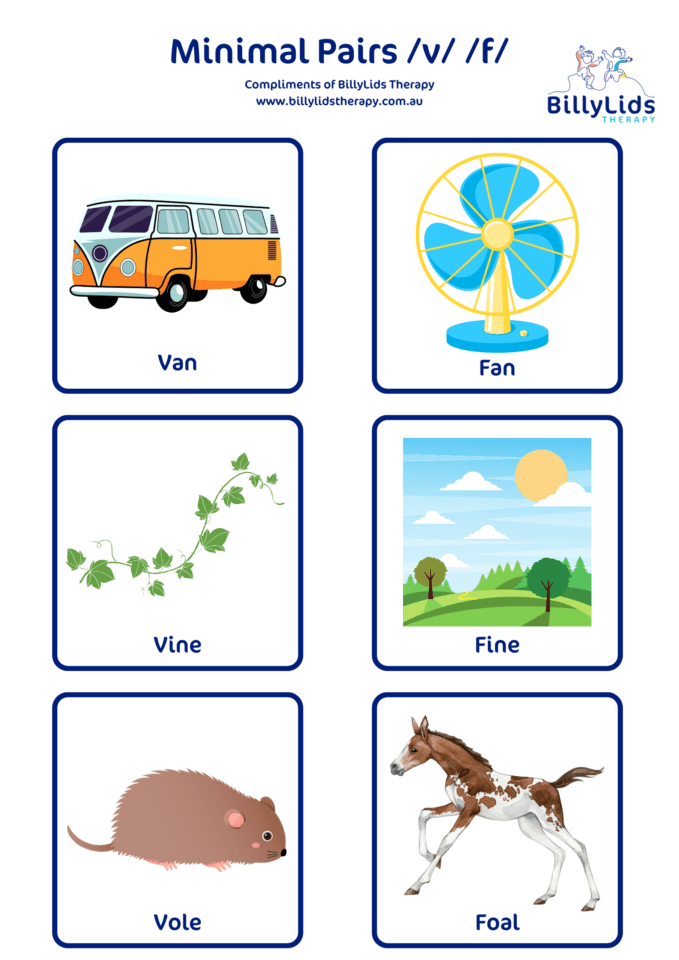
Minimal Pair /v/ → /f/
Word List
Van → Fan; Vine → Fine; Vole → Foal.
Free Downloads
Download v – f minimal pairs here
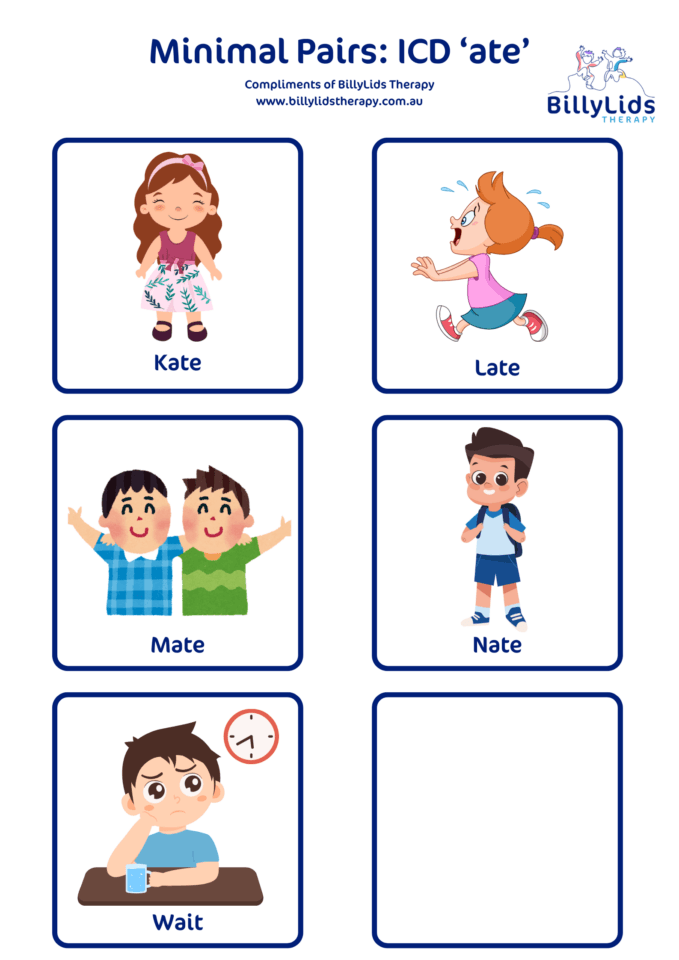
Errors of Phonological Processes: Initial Consonant Deletion (ICD)
Initial consonant deletion (ICD), a phonological process where the initial consonant of a word is omitted. This type of error affects the overall word structure and can significantly impact intelligibility (how easy it is to understand your child).
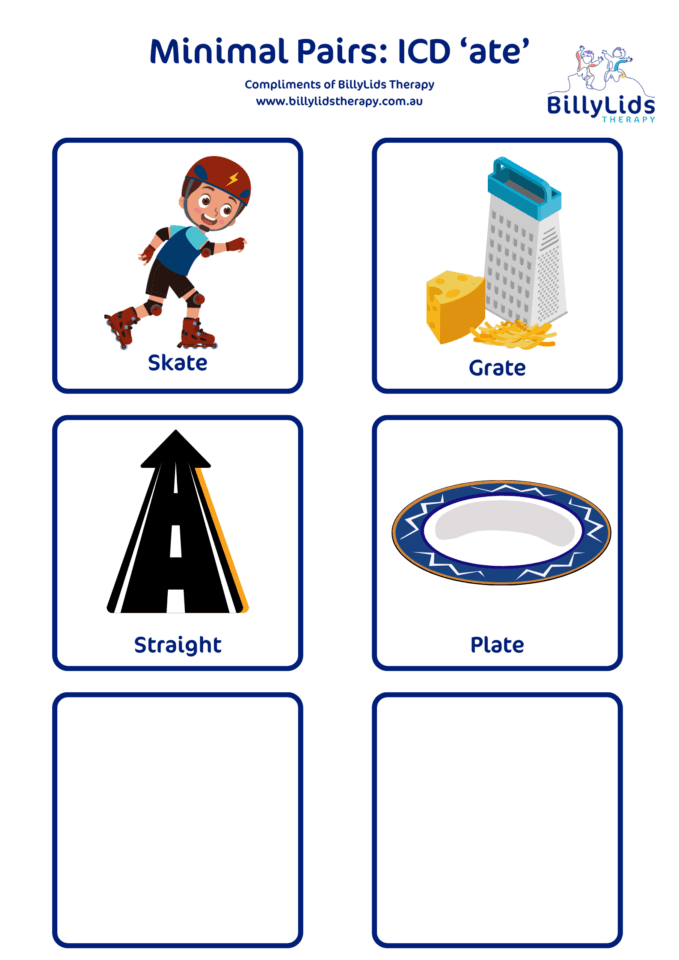
‘Ate’
Bait; date; fete; gate; Kate; late; mate; Nate; wait; skate; grate; straight; plate.

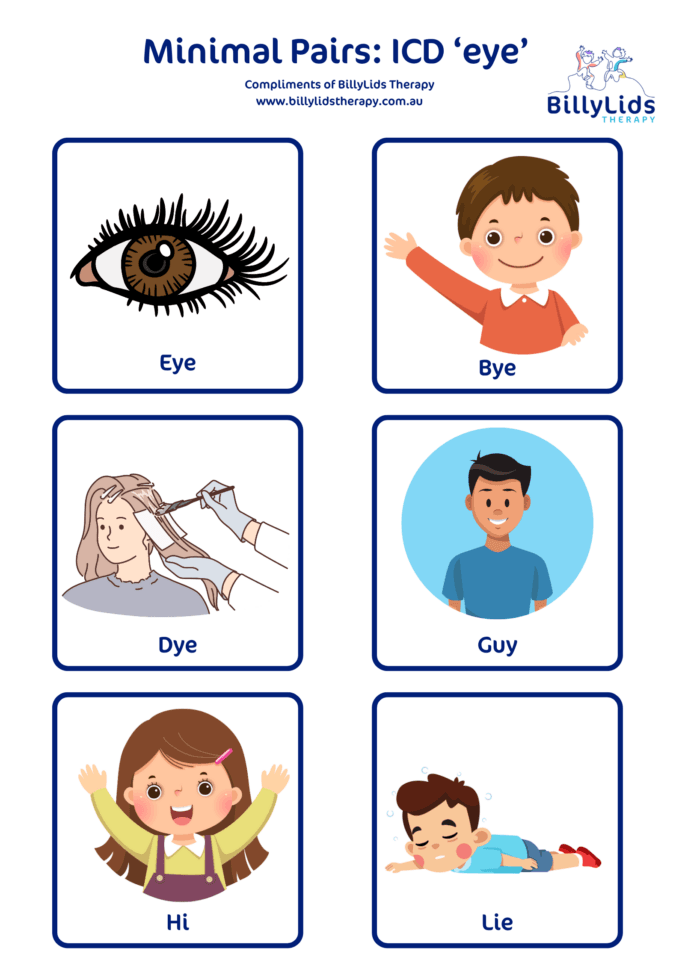
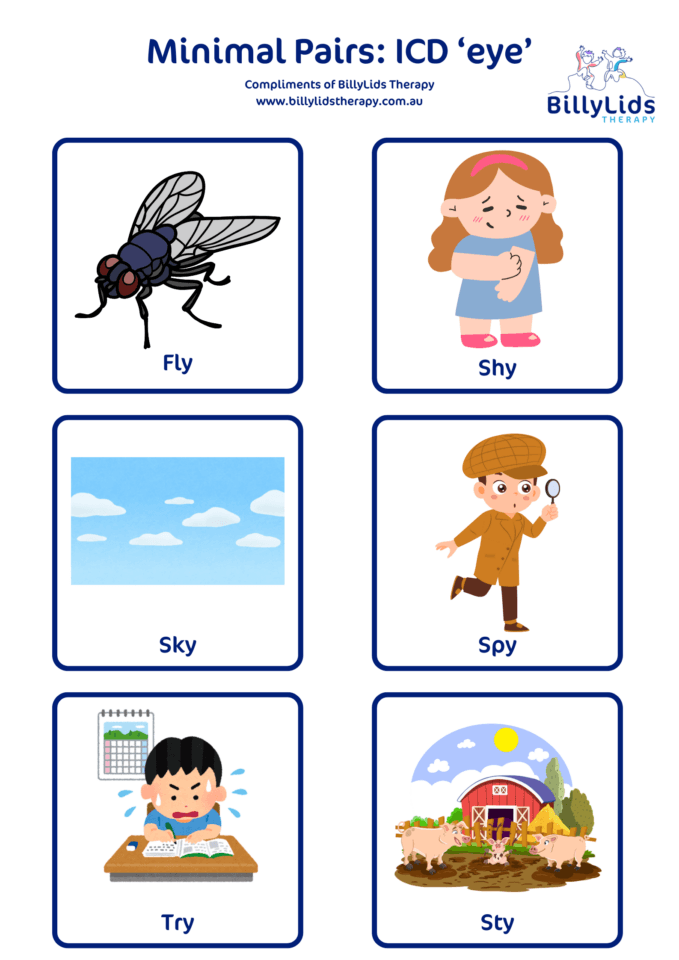
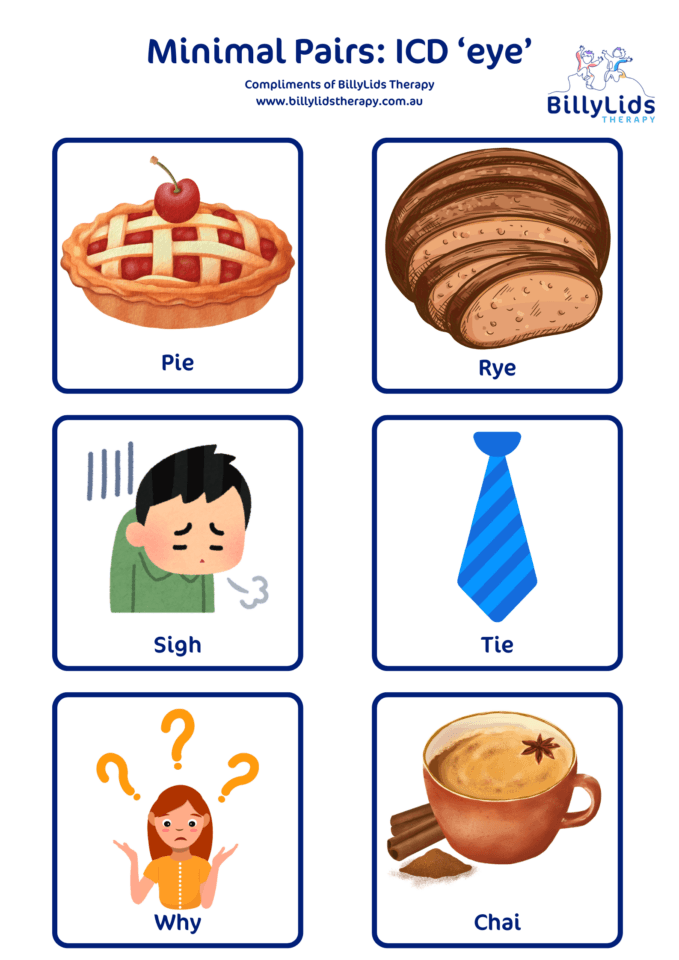
‘Eye’
Bye; dye; guy, hi, lie, pie, rye, sigh, tie, why, chai, fly, shy, sky, spy, try, sty.
‘All’
Ball; call; fall; hall; mall; Paul; tall; wall; crawl, shawl, small.

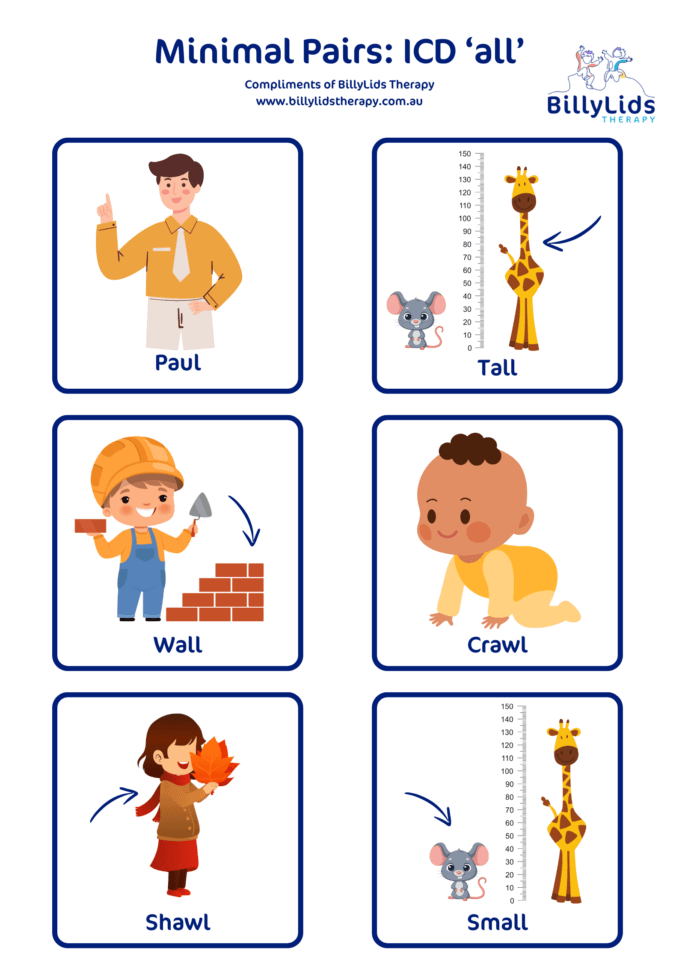
Download initial consonant deletion pairs here
Errors of Phonological Processes: Final Consonant Deletion (FCD)
Final consonant deletion (FCD), a phonological process where the initial consonant of a word is omitted. This type of error affects the overall word structure and can significantly impact intelligibility (how easy it is to understand your child).
FCD is commonly observed in typical speech development but may persist in some children beyond the expected age, indicating a phonological delay or disorder. It is also important to note that persistent FCD can be associated with hearing loss. Children with hearing difficulties may struggle to perceive final consonants, especially in soft or unstressed syllables, leading to challenges in developing clear and accurate speech patterns. Addressing hearing concerns early and implementing appropriate speech therapy can support improved communication and intelligibility.
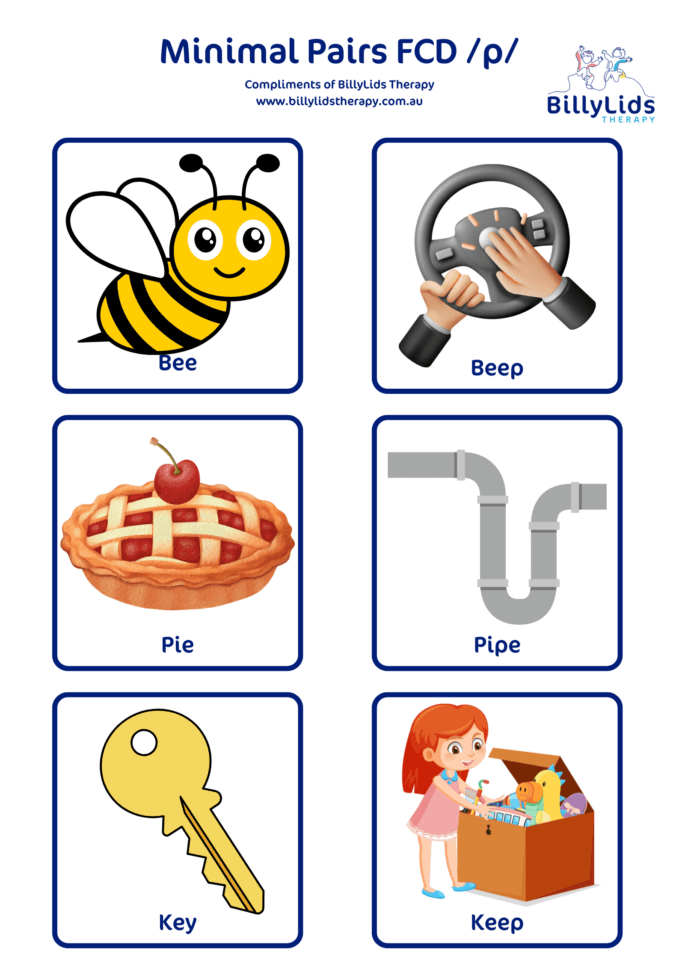
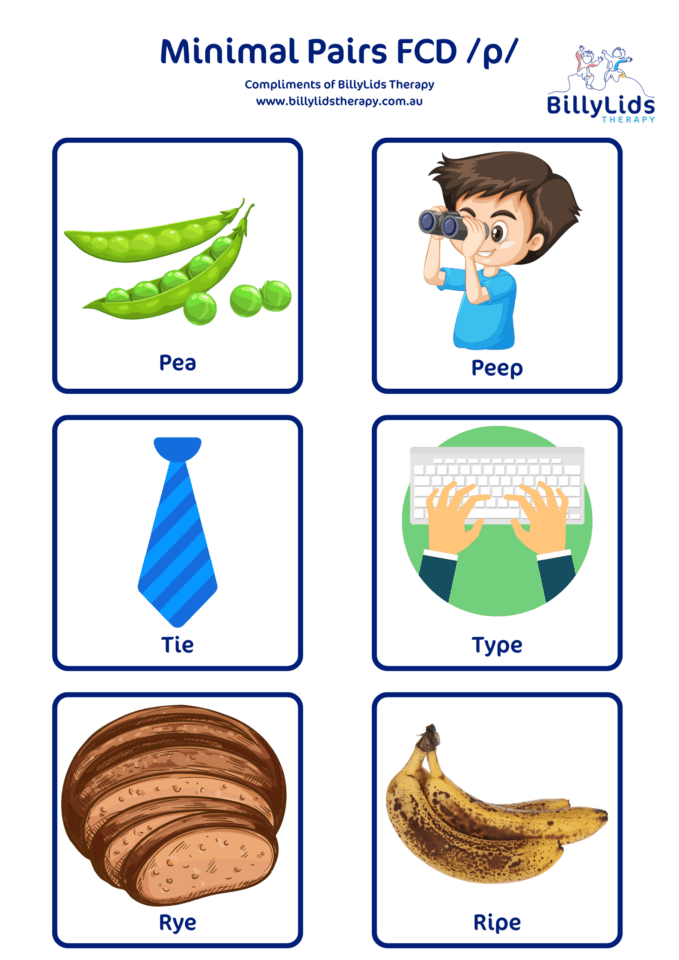
Final Consonant Deletion (FCD) /p/
Word list:
Bee → Beep; Pie → Pipe; Key → Keep; Pea → Peep; Tie → Type; Rye → Ripe; Who → Hoop; Sew → Soap; Grey → Grape.
Final Consonant Deletion (FCD) /n/
Word list:
Bow → Bone; Foe → Phone; Bee → Bean; Moo → Moon; Pie → Pine; Ray → Rain; Day → Dane; Grey → Grain; Spy → Spine.
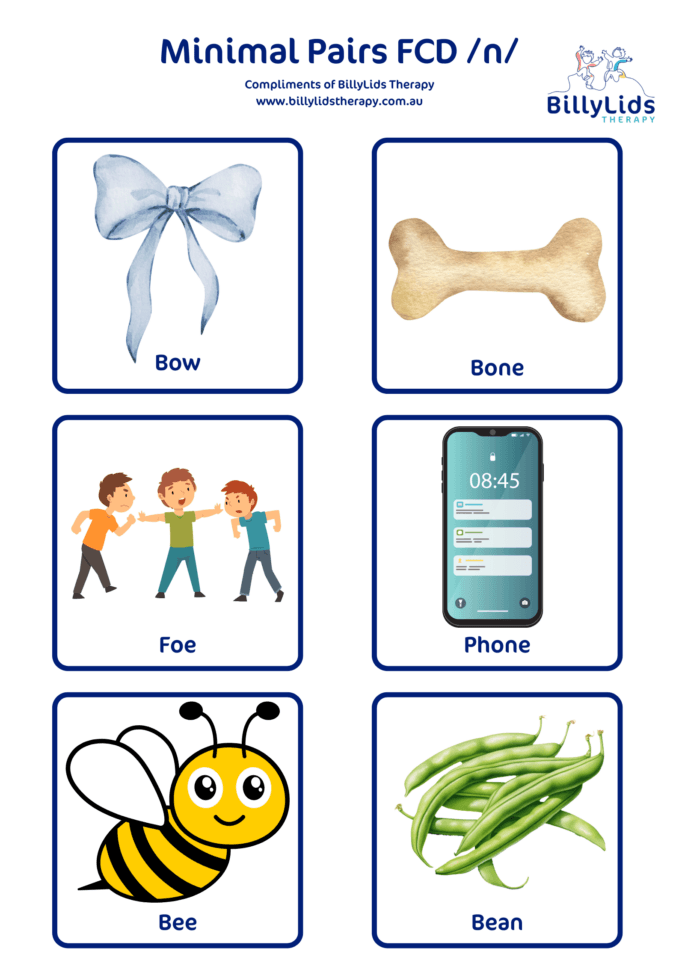
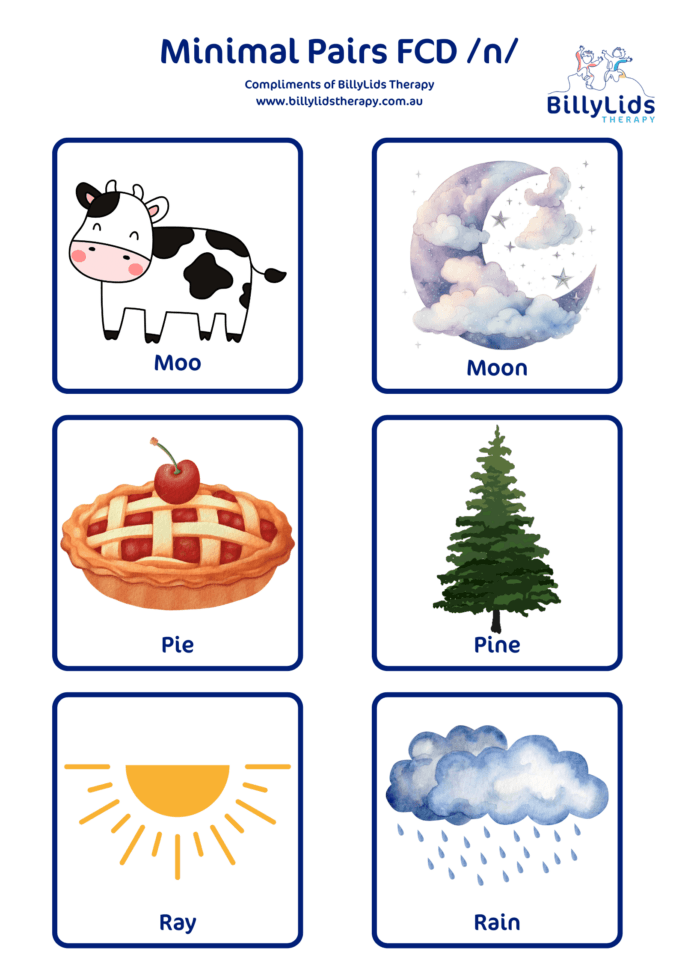
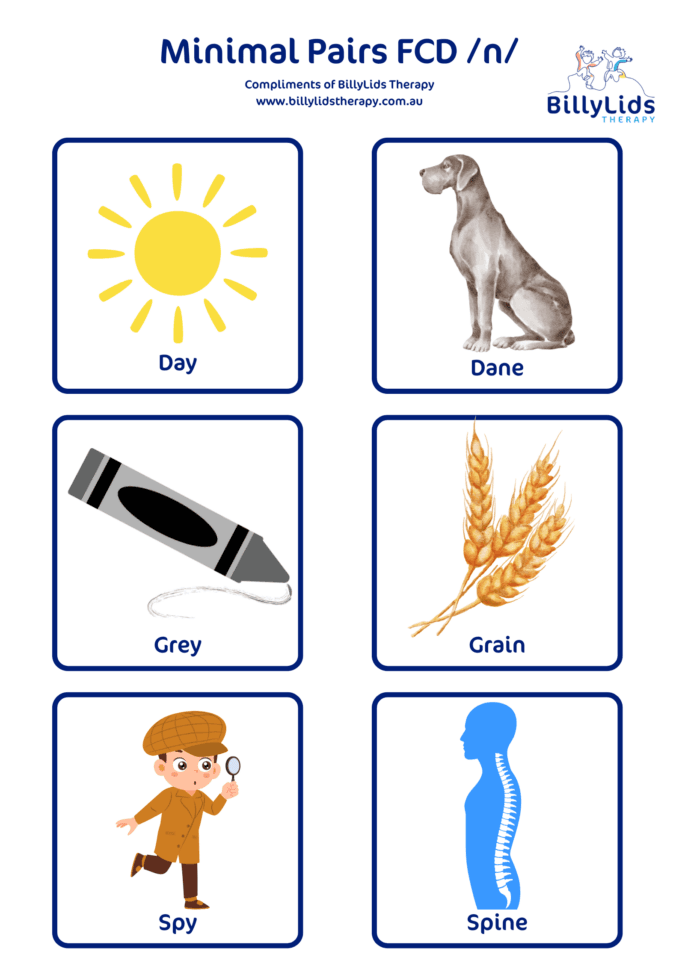
Download final consonant deletion pairs here
Initial consonant deletion [ICD] ‘ache’
Cot → Tot; Cub → Tub; Cap → Tap; Cape → Tape; Kick → Tick; Core → Tore.
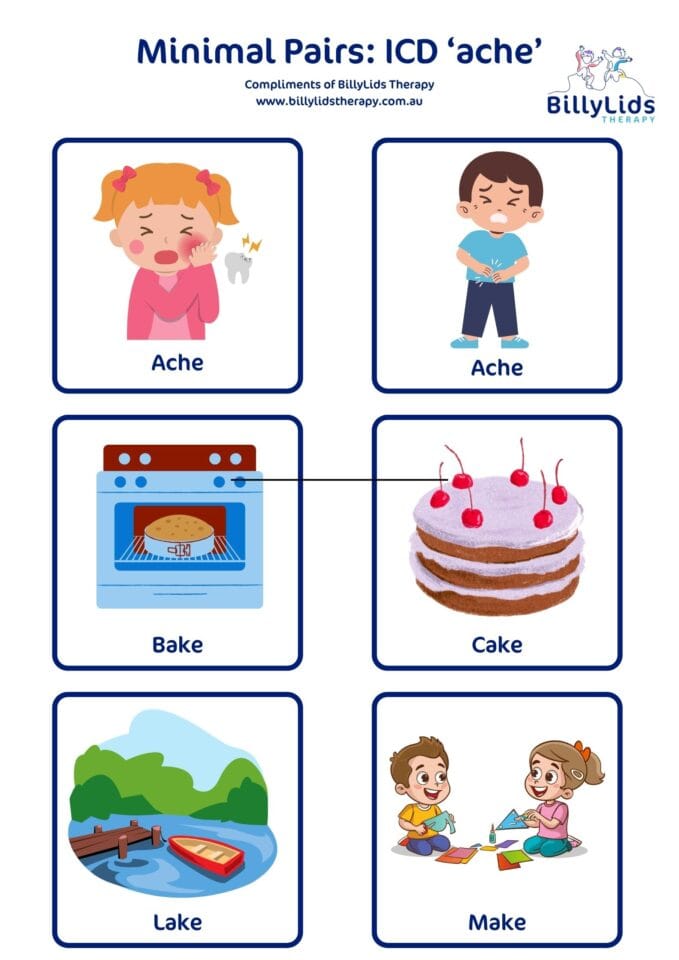
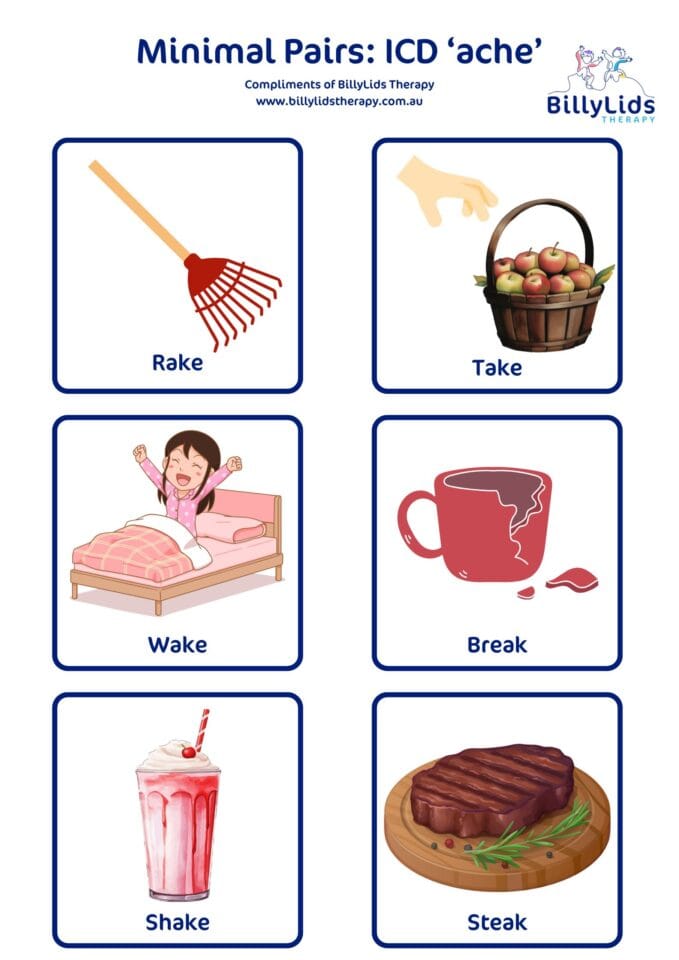
Download Initial consonant deletion [ICD] ‘ache’
FAQs
FAQs:
When Should Minimal Pairs Be Used?
Minimal pairs are helpful when a child struggles with specific speech errors, such as substituting or omitting sounds (e.g., saying “key” for “tea”). They improve listening and sound production skills, aiding children with phonological and articulation disorders. Early intervention with a speech pathologist is key.
How Do I Know If My Child Needs Speech Pathology?
If your child has difficulty being understood, misses speech milestones, or struggles with specific sounds, consider consulting a speech pathologist for an evaluation.
What Are Minimal Pairs and Why Are They Important?
Minimal pairs are word pairs differing by one sound, helping children hear and produce sound distinctions, improving their pronunciation and speech clarity.
What Are the Main Goals for Minimal Pairs in Speech Pathology?
The main goals are to improve listening skills, reduce speech errors, and enhance a child’s confidence and ability to produce clear speech.
Further Reading on Minimal Pairs:
“Helping Your Child with Speech Sound Disorders” – An overview of speech sound disorders, including the use of minimal pairs in therapy. Queensland Government
“Minimal Pairs in Speech Therapy” – A comprehensive overview of how minimal pairs are used to improve speech clarity in children. American Speech-Language-Hearing Association (ASHA)
“Speech Sound Disorders in Children” – Information on identifying and treating speech sound issues in children. Raising Children Network
“Speech Pathology: Supporting Your Child” – Guidance on how speech therapy works, including tools like minimal pairs. Australian Government – Healthdirect
“Phonological Therapy Using Minimal Pairs” – Research-based article on the effectiveness of minimal pairs for phonological disorders. Speech Pathology Australia